Showing posts with label Arizona gardening. Show all posts

Wednesday, March 31, 2021

Gardening alone after 41 years


Cleaning up our Arizona garden alone, spring and summer 2020

The last five months of Tom's life we spent in Old River, Texas, staying at the rent home of one of my sister's, a home that had once belonged to a great-aunt. The chemo having failed after a year of slowing the cancer, Tom was put on a trial cancer medication. However, the cancer either spread or the trial medication caused swelling and a blockage to his colon occurred. He was in and out of MD Anderson Cancer Center hospital a good part of April and most of May. Surgery finally eliminated the blockage, but there was no cure for the cancer. Told he would live just a few weeks, Tom lived for five more months in which we were able to return to our home in Arizona three times, a week each time. So the spring and summer of 2019, when we would ordinarily be gardening at our home in Arizona, was spent away from the garden we had created there.

When I returned to Arizona in December, a month after Tom's death, I found a weedy, overgrown garden, and in the spring of 2020, I was determined to clean it up myself. I set to work digging out the weeds and turning over soil with a shovel. It was hard work, and I relished it. Grief is a lonely experience, and there in Apache County, Arizona, in the middle of a pandemic, the loneliness increased. The manual labor kept me occupied in a way that no other activity could have done.

Cucumbers and Scarlet Runner Beans covering a trellis that Tom built

My 2020 crop of Sweet Armenian Heirloom cucumbers did very well.
As we had abandoned organized religion years before, our love of the natural world and our transient experiences with it became much more important to me and Tom. So in working in the garden, noticing the change of seasons and the abundance of all that we had cared for--the grapes, the apples, the flowers I had planted and those planted by a former owner that I tended, and now the few vegetables I chose to grow in the weeded garden--I was paying homage to Tom and to our life together.

I planted several kinds of sunflowers that summer of 2020

Cassie and I taking a break from gardening, summer of 2020
The first week of September 2020, I said a final goodbye to the last garden Tom and I had created together. Now I am trying my hand at urban gardening near Atlanta, Georgia, in zone 7b.

My yard here in Georgia is very shady. Two large water oaks in the backyard shade half of the front yard from early-afternoon, onward, and the backyard is shade or part shade. The water oaks are old; violets and monkey grass grow in crevices near the ground, and one tree has a large mushroom growth on it.

 When old water oaks begin to decay, the rot spreads rapidly in their roots, and they can fall more easily during heavy downpours or windy weather. However, a local arborist advised me not to have them cut down, and so I anxiously watch them in every windy storm that passes through.

Now I am trying to figure out how to garden in a partly shady yard, and I have been watching the movement of the sun across the property, a difficult task lately since we have had so many rainy or cloudy days. This will be my first garden without Tom's imprint. I want to make the best of it in honor of him and of our many years of gardening together.

Some of the produce from my 2020 garden in Arizona

 
Tom planting shallots in our Arizona garden, 2016 or 2017


Tuesday, October 3, 2017

The End of Summer: Harvesting and Canning

Pasta with homemade pesto & homegrown parsley & tomatoes
Yesterday I took the last big batch of basil that I had harvested from my kitchen garden and whipped up some pesto. I had meant to freeze some of the pesto in ice trays but then couldn't find the ice trays because they had been stored somewhere I can't recall when we had the kitchen remodeled this summer. My son-in-law, whose recipe for pesto I mostly followed, freezes his pesto in a small jar to use as needed. For last night's dinner, I mixed the fresh pesto with warm pasta, Sungold tomatoes and parsley that I had gathered that day in the big garden and in my kitchen garden. What a yummy dish that was.

Adam adds arugula to his pesto, and I have done that, too, as well as making an all-arugula pesto. The last time I made arugula pesto, however, the pesto was so bitter that I threw it out. Perhaps the leaves had been too old and tough, or maybe I need to do what Adam does: include a small portion  of arugula and a larger portion of basil in the recipe (Adam also substitutes spinach for the smaller portion of arugula).

What is the best thing about gardening? Is it the winter planning, the leafing through gardening catalogs or, these days, scrolling online through gardening and seed source websites?  Is it watching those first seedlings magically appear? Or going out every morning to check on the ripeness of tomatoes? Or is it harvesting the produce, eating it fresh, or canning it for later?

This past weekend, in the middle of tomato canning, Tom said, "I love doing this!" The tomato canning continues over weeks as tomatoes ripen on the vines in the big garden and in the greenhouse. We grew a lot of yellow tomatoes this summer (Lemon Boy, Golden Jubilee, Big Rainbow) that Tom canned separately from the red tomatoes.
On the left, Tom's canned tomatoes; on the right, his canned beets
After we returned from our daughter's wedding in Georgia, I gathered grapes from the large vine that we've trained to grow on the chain-link walls of my Secret Garden room (a dog kennel left by the previous owners that I decorated as an outdoor room). Birds had eaten quite a few of the grapes--I often startled a juvenile robin among the grape vines this summer--but there were enough grapes left for sixteen half-pints of what I labelled our Lavender Blue Grape Jelly. I suggested to Tom that he add some lavender blooms from my kitchen garden to flavor the jelly.
a bunch of grapes on our grapevine
more grapes than apples this year (late freeze killed the apple blossoms)
Here at the foot of the White Mountains, an early freeze can take out a garden with tomatoes still green on the vine. Several days ago we had a couple of nights of predicted freezing temperatures, so I gathered all the peppers and many of the tomatoes, leaving a lot of green tomatoes, hoping that temperatures wouldn't drop so low as to kill the vines completely. We are still in the process of freezing and drying the bumper crop of poblano peppers. Tom has put to good use the dehydrator I bought for him a few months ago.
an anxious harvest before a freeze
a tomato galette I made with Sungold and Indigo Ruby tomatoes
My aunt Lynelle Sikora suggested that I make chow chow out of the green tomatoes, so we did a test run of a small batch this past weekend.  I knew I liked chow chow as I had grown up eating it as a side dish, but I wanted to make sure that we both liked it well enough to make several pints instead of a few half-pints. The end result was tasty, so I have decided to can more of the sweet tomato relish this week.
The tomato mix (green tomatoes, red and green peppers, onion, pickling and canning salt) stands in the fridge overnight. Then the mixture is drained before cooking it with spices.

green tomato relish mix cooking in the spices (light brown sugar, yellow mustard seeds, whole cloves, minced garlic, celery seed, red pepper flakes--I used three red peppers from my kitchen garden rather than dried pepper flakes)
a small batch of chow chow


After the next round or two of tomato canning, it will be time to clear the garden in preparation for next year. I will then clean out the chicken pen, raking up all the straw, chicken crap, and vegetable matter remaining from the scraps I and my neighbor have thrown to the chickens this summer. I'll fill up a wheelbarrow with the yard waste as well as the waste from inside the henhouse and spread it all on the garden. Winter's snow will pack it down, and in the spring, Tom and I will dig the composted chicken waste into the soil to feed another summer garden.

I still have a few herbs I hope to dry for the winter, and then my gardening for this year will be done. But our firewood gathering for the winter has just begun.


Wednesday, September 6, 2017

Going into Fall: Garden Update

Here near the White Mountains of Arizona, the tomatoes in our outside garden began ripening in August after the cherry tomatoes in our greenhouse began turning golden and red in late July. Again this year, we have way more cherry tomatoes than we can eat right away so Tom began dehydrating them. They are very tasty dried, crunchy and tart-sweet, and I can't wait to try them in a pasta dish or soup this winter. 

The basil, which I planted in July, took a little longer to grow in the cooler monsoon weather. The plants certainly don't grow as tall here as they did in the warmer, wetter climate of southeastern Louisiana. Next year I'm going to try growing a few basil plants in our greenhouse, where this summer and last, tomato plants have pushed against the ceiling and walls, making the greenhouse a maze to negotiate. Later I plan to make some pesto with basil that I picked yesterday and today; the plants are beginning to bloom, but I've been pinching the blooms, hoping to encourage more growth in the last warm days of late summer.

I am very happy with my kitchen garden, which took a little while to take off in the cooler weather of spring and early summer. We will see if any of the perennials--rosemary, oregano, thyme, mint--will survive the winter.
kitchen garden in back yard
basil, orange mint, rosemary in kitchen garden
peppers, oregano, basil, thyme, parsley, tarragon in kitchen garden
In mid-summer, I planted sunflower seeds from a packet I had bought off a local hardware shelf, and those plants are now blooming. A couple of sunflower plants sprouted early in the garden, free sown probably by some passing bird, and those began blooming in the early summer. I love a garden that's a little messy with such surprises, unexpected blooms and wildly overgrown plants exhibiting their uncontained nature. 


sunflower surprise--Winds blew down one plant, but it continued to bloom


This past weekend I dug the potatoes that Tom planted in the early summer. The harvest was not quite as large as we had hoped from the one row that Tom planted of white potatoes he bought at a nursery in a nearby town and the few red potatoes he planted from a grocery purchase that had sprouted in our pantry. However, those white potatoes are very tasty cooked with the purple snap beans we planted. I add sauteed onions and garlic to peeled and diced potatoes and snap beans and just barely cover with homemade vegetable stock, cooking until the potatoes are soft and the beans still slightly chewy. Tonight I think I'll cook the potatoes with dill from my kitchen garden. 
The potato digging begins.
the first pail of white potatoes
The squash was very prolific and is still blooming though the blooms are fewer than earlier in the summer. Tom saved the seed from plants we grew last year, and at least one of the plants that sprouted seems to have crossed with gourds that I grew last year, a little too green-tasting for consumption so I am letting the fruits grow to see if they will harden like gourds. If the cross-pollinated fruits prove disappointing as gourds, maybe the chickens will like the seeds. The peppers we grew also produced well. I love cooking vegetable casseroles with various combinations of bell peppers, poblano peppers, squash, onions, tomatoes, and grated cheeses. 

Gardening ..... good for...


the body...
...and soul...


Enough at summer's end
(from my journal)

Cassie the cat chews on leaves of blue grama
in the shade of a pear tree planted
by a previous owner undaunted by 12-inch annual precipitation
in this Round Valley of volcanic mountains and ancient ridges of lava flows.
The leaves of cowpen daisy shrivel in the dry approaching fall,
summer's monsoon now a memory of moisture.
Cassie curls up in soft mounds of last year's hay I scattered
to mulch the wilder area of our backyard,
flags of blue grama waving above her in the breeze.
Her ears twitch at every sound--a neighbor's truck slipping into a covered drive,
a bird calling from a nearby, summer-long unmowed yard,
a small dog barking, and the dry whir of grasshopper wings.
As I sit here the pain in my jaw recedes, 
a lifetime of teeth problems willed away by quiet beauty.
For a little while, this moment, this blue sky, these fading flowers, 
and the companionship of a shade camouflaged cat....
are enough.

Anita

Thursday, August 3, 2017

And When They are Old They will not Depart from It

I began gardening as a young child, hoeing weeds in my parents' garden, picking peas in my maternal grandmother's garden, and working in the flower beds of my paternal grandmother's garden. As a child, I wandered the fence rows of the eight acres we lived on in Old River, Texas, picking blackberries and nibbling on the seeds of peppergrass. Those eight acres were once a part of a much larger portion of land owned by some of my ancestors, the remaining of which my grandparents and an uncle owned, across the gravel-topped road of Woodland Lane from our house on a hill.

When I was a teenager, one of my first cousins became interested in gathering wild food; I think Karen had read a book by Euell Gibbons, the natural foods guy whom I remember from his claim that many parts of a pine tree are edible. Several of us tested that claim by brewing up some pine needle tea. It tasted terrible, even with added sugar. Then we crawled under a barbed wire fence to gather purslane (Portulaca oleracea) in a pasture next to my cousin's house. Karen had directions on how to cook this prolific plant native to India and Persia; though it's grown as food elsewhere, it's primarily considered a weed in the U.S., except for its cousin, the moss rose (Portulaca grandiflora), which is grown for its colorful flowers.

We boiled the purslane in a pot on my aunt's stove and added butter and salt. I remember having a chance to taste it--a flavor I compared to boiled okra--before my uncle "cottoned on" to what we were doing. He grabbed the pot and flung its contents out into the backyard. "You're going to poison yourselves!" he yelled, thus cutting short our culinary adventure. He was afraid that we hadn't identified the plant accurately.

I haven't eaten purslane since though I have often pulled it up as a weed.

However, those early gardening and foraging experiences have remained with me as I have long been an avid gardener. As college students in the early 1980s, Tom and I gardened in a small plot on land owned by Texas A&M University in College Station, Texas. The university would hire someone to disk up the land and then divide the land into plots. Those of us who lived in married student housing were then invited to choose a plot on which to raise vegetables. We did this for two or three years and grew such a good garden that students toiling in neighboring plots were envious of our success. They were convinced that we had somehow managed to procure a naturally better plot than they--though our trucking in chicken manure from the Poultry Science department and my getting on my hands and knees to pull weeds were the true causes of our success.

So one year, someone rushed to choose the plot we had had the previous year, and, coming in later to the choosing process, we ended up with a corner plot that hadn't been improved. Not daunted, we improved that plot as well, and somewhere I have a faded photo of my twenty-something self standing among flourishing green corn stalks.

Tom and I have gardened together ever since those early days of our marriage as poor college students, from Texas to Louisiana, to Minnesota, to Georgia, and back again in those three states before our latest gardening experiences here below the White Mountains in eastern Arizona. Over the years we've tried new plants, such as mesclun mixes and arugula, some of my now-favorites for green salads, which I first began growing in central Texas. In the late 1990s in Georgia, we began experimenting with heirloom tomatoes, such as Green ZebraYellow Pear, and Cherokee Purple. I would slice up a colorful collection of heirloom tomatoes, season the slices with a little salt and arrange them on a white platter--a dish I called "tomato snacks" to encourage my young children to eat their vegetables. The colorful palette worked.

For almost 40 years, Tom and I have planned our spring gardens together, reviewing the stock of seed we have saved from previous years, poring over seed catalogs, drawing up ideas for new garden arrangements. I imagine that as long as we have a plot of land somewhere, we'll be gardening until we are unable to hold a hoe in our hands or press seeds into soil. 


our Arizona garden, early August 2017
the kitchen garden in mid-July
This is the first time I have grown hollyhocks successfully--and these came up volunteer.

This is one of several different pepper plants--getting big!
from Fall/Winter 2008, Atlanta Review


Sunday, May 7, 2017

Spring at Casa Malpollos


Snow covers peach blossoms on March 28, 2017
Last year we put in our first full garden in Arizona where we live near the White Mountains, at 7200 feet above sea level. Most of our gardening experience has been in the South (Texas, Georgia, Louisiana) except for a couple of years in northern Minnesota. The monsoon season begins here at the beginning of July, and most long-timers don't begin planting until May. However, we decided to experiment, and I planted cool season seeds (arugula, mesclun mixes, radishes) on April 10th. I followed suit this year, and these cool season plants survived the late freezes that are common here. But the warmer season plants that survived early planting last year were hit hard by those late freezes this year.

The weather here is not consistent, and gardeners are frequently disappointed. Friends who live just five miles away, nearer the Little Colorado River and at a little lower elevation, have never had apples from their apple trees. Yet last year, even though many blooms were killed in a frost, we harvested plenty of apples for canning. This year, we had such warm weather in March that we were encouraged by all the peach and apple blooms. Then the area turned colder, with freezing temperatures and snow the last week of March. 
the snow of 27-28 March 2017--peach tree full of blossoms, covered with snow


We were amazed, however, to see tiny fruit swellings on the peach, pear, cherry, and apple trees--only to be disappointed again by a late freeze and snow on April 29th and 30th. All the little fruits were killed, as well as the tiny, curling leaves just emerging on our grape vines. Even the hardy, ornamental Russian sage was killed back, its spring leaves withering in the cold. I wait to see if those will sprout back. 
The snow of April 29-30, 2017

The garden after the snow of April 29, 2017
With so many spring-flowering plants affected by those snows, the bees, which had been covering the blooms of the fruit trees, began swarming the hardier plants. I had planted arugula and mesclun mixes last fall. The plants hunkered down, survived the winter, and are now in bloom and full of bees every day.
Arugula and mustard flowering in the early spring garden--These plants survived the winter.
The arugula, mesclun mixes, and radishes we planted in early-to-mid April are doing well, potatoes have sprouted, and the garlic has 5- to 6-inch leaves. The parsley that I planted by seed last year also resprouted; they are biennial plants. Today I made a great salad with those greens and parsley.
Arugula and mixed mustards, early May garden
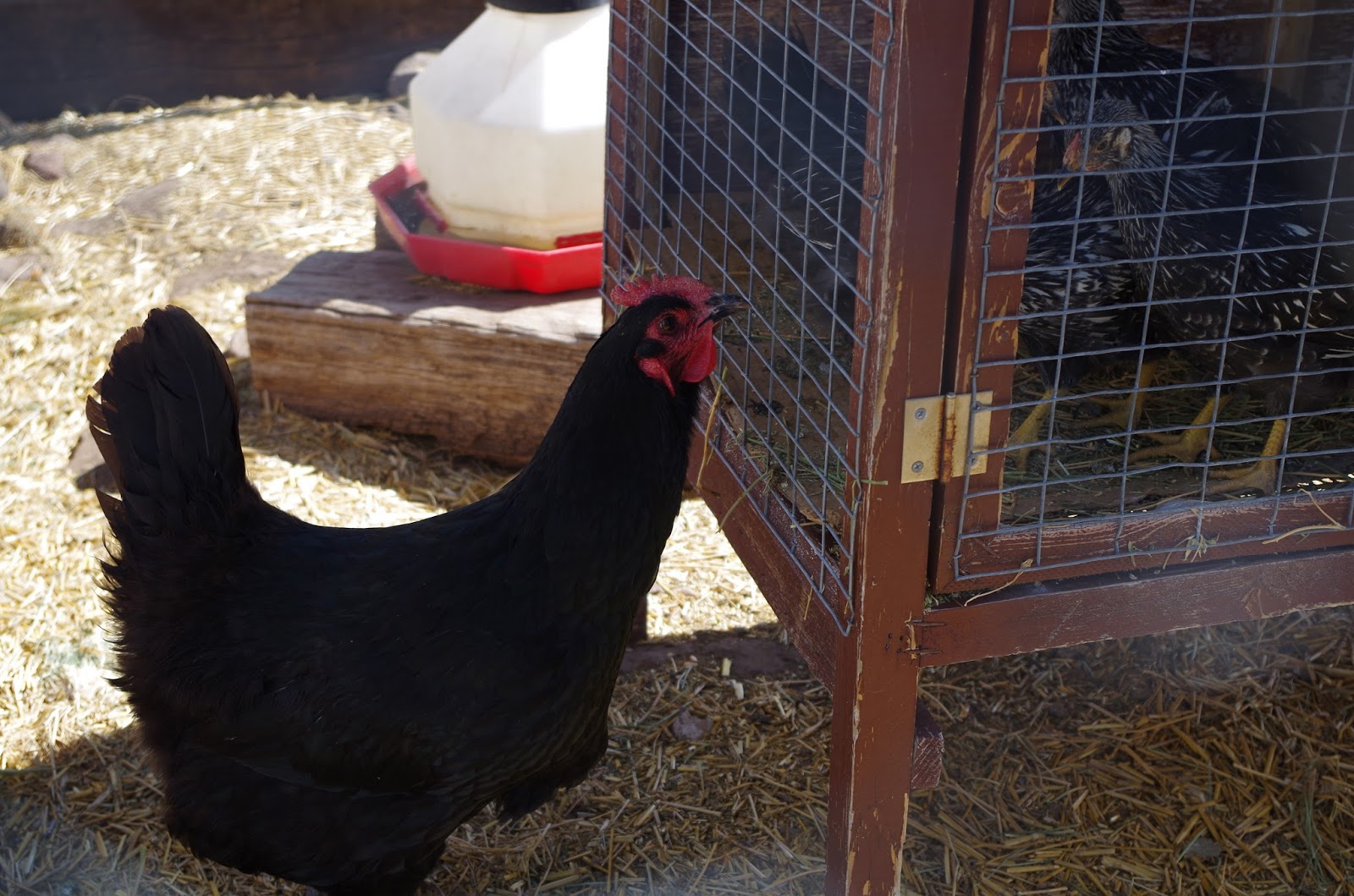
We have also added to our animal quotient on our little half-acre "suburban farm." When we bought this house, the previous owners had chickens and turkeys; we kept the chickens, ate the roosters, and now have four hens left from the original flock. In March, I purchased six little Wyandotte chicks (purported to be pullets at the local feedstore so there better not be any cockerels among them!). For the first three weeks, we kept the chicks in a large box in one of our spare bathrooms where we could set up a heater as well as a heat lamp. Then, as the weather warmed up, we moved the chicks to a rabbit hutch that we put in the garage, again with a heater and heat lamp set up to keep the growing chicks warm. Yesterday we moved the chicks to the hen house. They are in a small cage that Tom built in order to help the older hens and chicks become acquainted, with as little anxiety and pullet pecking as possible. In a week, we will release them into the larger hen yard.
One (of the two) black hens checks out the chicks yesterday (6 April 2017)
chicks in the hen house--The cage will keep them separated from the older hens for a week.
Now we are experiencing the high winds that the area is famous for--wind and very dry weather. Gardening here is a challenge, but so far, we've been up for the challenge.


Wednesday, November 16, 2016

Preparing for Winter....when it comes


honeybee on California poppy flower 
This past weekend and into this week, Tom and I have been cleaning up our place, preparing for winter. Winter seems to be tarrying elsewhere, though. Yesterday I stopped by a local antique shop and while paying for my purchases, asked the owner if it seemed unseasonably warm here. She told me yes, that the area usually gets its first snow in October. However, last winter, our first here, we didn't get snow until December, if I remember correctly.  The U.S. climate data website supports my memory. In November of last year, the highest temperature in November was on the second of the month, with a high near 74°F, while highs the rest of the month varied between 66°F and 42°F, with lows between 45°F and 7°F. Well, we've had a balmy fall, with highs in the 60s and 70s almost every day, giving us a great opportunity to work outside.

Tom cleaned out the greenhouse this past weekend, pulling out tomato and pepper plants and replacing them with onion plants. We have a lot of onions in the outside garden, so we'll see how well the onions outside survive the winter as compared to those inside the greenhouse. 
Tomato plants stacked up in front of the greenhouse, Tom and Cassie on the right
greenhouse cleared of tomatoes and peppers
onions, radishes, greens, cabbage still growing in the garden
Tom also affixed a rain gutter to the greenhouse and used plastic gutter material to direct precipitation into the greenhouse.
gutter added to the greenhouse, with downspout for directing precipitation inside
drainage gutters for directing precipitation in the greenhouse
I finally turned to a project that I had procrastinated on because it was a little overwhelming, repairing the gravel walkway in our backyard which the previous owners' dogs had torn up. To do this, I would be tackling two projects at once, adding to the walkway the gravel I'm removing from an area where we plan to put in an herb garden. Photos might describe these projects best.
The area where we plan an herb garden: I am removing gravel and the underlying plastic.
I'm recyling the plastic ground cover and gravel to cover bare areas in this gravel walkway.
Here is the area repaired, with gravel covering the plastic.
When I get all the plastic ground cover and gravel removed from the area where we are planning an herb garden, Tom will dig up the ground (I've asked for his assistance in this), and then we will put in walkways and separate raised beds. I hope we can get this done in time for spring planting. 

Another project I'm working on this week is repairing the rock "creek" that was part of the original landscaping of a previous owner. The "creek" was neglected and filled with debris.
The rock "creek" that had been neglected (photo taken in March)
Dirt, gravel, and other debris had filled in the rock "creek" bed.
This week, I cleared out the debris and uncovered buried rocks in the "rock creek."
Tom said yesterday that I was going to get the yard all in order in time for us to move again. "Well," I replied, "that would be par for the course." The 2016 presidential election has already impacted some of our hopes for the future. I just hope that the fallout will not be as bad as we imagine.
scrub jay at my makeshift bird feeder--some flowers still blooming in mid-November