Showing posts with label pollinator garden. Show all posts

Monday, March 27, 2017

A Reflection on the First Bees of the Season

one of the first bees I've seen this season--several buzzing around peach blooms
For the past few years I have been stalking bees and other pollinators in my gardens, first in Louisiana and now in Arizona. Taking photos of pollinators has opened up a whole new world to me, a world that we usually pass with little thought. I have identified creatures that I didn't even know existed and have watched dramas unfold in flowers. Paying attention to bees, wasps, moths, butterflies, and other pollinators has also made me more aware of the importance of sharing this world responsibly. It's an awareness that's gaining ground with a lot of people, including some corporations. 

The breakfast cereal Cheerios recently highlighted the plight of bees, some species of which are disappearing from our landscapes in record numbers, in a campaign the company called #BringBacktheBees. Every package of Honey Nut Cheerios provided information that encouraged customers to go online to order free packages of wildflower seeds (over 1.5 billion seeds, according to the Cheerios website). In addition, General Mills left a blank space on its packaging where the cereal's mascot Buzz the Bee usually appeared. The ad certainly had an important message, but like a lot of advertising, it over-simplified the problems of reduced habitat and threatened and endangered species. Some of the flower seeds included in the packets are native to some areas in the United States, but not others. This might not be a problem, necessarily, but the flowers might not be ones that native bees of an area usually pollinate.

The other issue is that while honeybees have had some serious problems in hive die-off and those problems have transferred to feral populations of honeybees, it's the native bees that are most seriously endangered. Honeybees are exotic to this country, introduced from Europe by white settlers. Because honeybees are used commercially in agriculture, from those bees transferred from farm to farm to pollinate fruit trees to those bred for honey production, European honeybees will always have moneyed support to fund research when a serious issue arises. Native bees and other pollinators, however, are extremely important in pollinating native plants, and these pollinators are often overlooked in popular Save-the-Bees campaigns. 

According to the U.S. Fish and Wildlife Service, pollinators face threats from habitat loss and degradation as well as over-use of pesticides:
As native vegetation is replaced by roadways, manicured lawns, crops and non-native gardens, pollinators lose the food and nesting sites that are necessary for their survival.  Migratory pollinators face special challenges.  If the distance between the suitable habitat patches along their migration route is too great, smaller, weaker individuals may die during their journey.
According to research, native bees do a tremendous amount of work pollinating fruit and vegetables, with honeybees supplementing that pollination. In the words of one researcher, "honeybees can't do it alone." Native bees are most efficient in pollinating watermelons, tomatoes, blueberries, and squash, among other fruits. I have witnessed squash bees pollinating our squash plants here in Arizona. 
bee in squash flower (I took this photo in our garden in 2016)
And every year I listen for the arrival of bumblebees in our tomato patch. They seem less prolific than other bees. Yesterday while trying to take photos of bees visiting the blooms on one of our peach trees (blooms which will probably be hurt by freezing temperatures expected this week), I heard and then saw one lonely bumblebee buzzing around the blooms at the top of the tree. 
This was the best photo I could get of the first bumblebee I have seen this season.
Bombus huntii?
I have never understood the urge to create large, uniform swathes of green lawn and roadsides, and knowing what I know now about the degradation of pollinator habitats, I am even more adverse to those boring expanses of green, often made even more desolate by pesticides. In Louisiana, I let a large patch of daisy fleabane grow in a corner of our yard and was rewarded with being able to view and photograph the hundreds of pollinators that visited that patch. 

Here in Arizona, I am encouraging patches of native flowers as well as allowing dandelions to grow in the small grassy lawn that a previous owner planted in front of our house.
dandelions in our lawn
Yesterday I counted four different species of bees pollinating the peach blossoms in one tree (with the coming freeze, at least the bees got some pollen; we're not likely to get peaches.) Each species had a different buzzy hum. The natural world is full of music, if we only stop to listen.
bee landing on a dandelion in our front yard
bee landed and at work gathering pollen
deep in pollen

Monday, November 3, 2014

The Melancholy Loveliness of Late-Fall Gardening

iridescent green bee on wild mint
Yesterday we heard the song of the white-throated sparrow for the first time this fall. The sparrow winters in the south and breeds in the north. The first time I heard its call was in a coniferous forest of northern Minnesota; its song was one of the most beautiful things I had ever heard, coming as it did, waveringly, through trees that had not yet become familiar to this daughter of southern pines and Gulf Coastal grasses. Its melody conveyed a hint of cool Arctic air, spicy scent of balsam fir, and a sense of melancholy. I never forgot it. Now, here in southeastern Louisiana, I look forward to this memory of Minnesota made flesh in the flash of a winged shadow in the bushy edges of our yard and in the song that intimates to me presences loved and lost.

The white-throated sparrow arrived with unusually early cold weather. Temperatures dipped to 32°F where we live and broke record lows in towns nearby; the average low for this time of year is 53°F. Fearing frost, I had spent the previous afternoon cutting lemongrass leaves to dry for tea--a task I had promised to do for my daughter who is living in Wyoming--gathering what I thought might be my final bouquet of zinnias for the year, making room for cold sensitive plants in our sunroom, and covering the plants I could not bring inside. We had no frost, however, so the lemongrass still lives for another harvest or two, but our sunroom remains filled with the plants of semi-tropical climates: a pink-flowering bougainvillea, poinsettias, ginger, a red-flowering geranium, a Buddha's hand citrus, and a couple of reed palms.

Our gardens, the larger vegetable garden and the smaller flower and herb beds around our yard, are full of late-fall blooms and ready-to-eat tender greens. In late summer, I cleared away the crusty remains of the zinnias of summer to make way for re-seeded plants, which are shorter and more attenuated than their summer parents but covered with flowers. They began blooming in time for the early fall arrival of gulf fritillaries, painted ladies, yellow sulphurs, and a few swallowtails. In the northeastern corner of our yard, I had allowed native fall aster to spread and grow throughout the summer and have been rewarded not only by a profusion of blooms in plants that can be head-high, but also by the hundreds of bees that busily collect pollen as the shadows of a nearby bamboo hedge retreat during the day. The bees are so besotted with this wild bouquet that they have almost abandoned my cultivated blooms.
partial view of the fall aster patch on an October morning
Paying closer attention to pollinators as I have the past two years, I have noted what plants seem to attract the most bees and other pollinators. The fall asters have attracted several different kinds of bees and wasps, while in a nearby patch of tiny wild mint, I can always spy an iridescent green bee or two flitting from one minuscule bloom to another. These little bees are difficult to photograph, as they seem very wary and fly very quickly in a zigzag pattern. I have noted several sizes of bumblebees; some very large bumbly-type bees love the big yellow luffa flowers. One morning I ventured into the aster patch while it was still in shade, and I discovered dozens of very tiny bumblebees hanging from the blooms and branches where they had over-nighted and were waiting for the sun to warm their wings so they could begin their daily work.


another view of a wary green bee
tiny bee on a fall aster bloom
closer look at the wild mint, to illustrate its size in relation to my fingers
Some wasps are pollinators, too.
black bee-like fly
a hornet-like pollinator
We are already enjoying salads of mesclun and tender mustards from the larger garden and also from the herb beds where I planted seeds of dill, arugula, and mixed greens in late September. The last few weeks have been dry, so I had to water the tender sprouts as they emerged. The habanero peppers, ghost peppers, and green peppers are still bearing, and the luffa fruit are huge. We are a little worried, however, that the luffa will not develop into the dry, spongy product one associates with bath time. The fruits are still green and soft. My gourd crop has been disappointing; too many gourds dropped from the vines and rotted in the hot humid weather of southeastern Louisiana.
a luffa fruit
foreground, arugula, mixed greens among the remains of summer's basil; background, flowering Mexican tarragon
Although temperatures are warmer today, we will have cooler weather again, and pollinators will die or hibernate, some maybe venturing out occasionally during milder winter weather. This morning I heard the song of the white-throated sparrow again as I watched the sun rise above the pines. It will keep me company through the late-fall and winter as leaves fall and flowers fade.
one harvested row of this year's sweet potatoes
second harvested row of this year's sweet potatoes

Sunday, September 28, 2014

The September Garden

habanero peppers
This morning under an overcast sky, the temperature hovers around the mid-70s Fahrenheit. After two or three weeks of neglecting the garden, I ventured out in the early morning while the dew was still on the grass and weeded two of my 8ftX8ft raised herb beds. Although rain has been predicted for today (80% chance), only a few sprinkles fell this morning, and while the soil still has moisture in it a few inches under the surface, we have had a rather dry September. The seed Tom planted in the big vegetable garden a couple of weeks ago has failed to sprout except for one or two little plants. Tom didn't water the seed when he planted it, thinking that rain would soon do the job. Onions are up, however.

The soil in my herb beds is also depleted of nutrients. We scattered some commercial fertilizer across the surface, but that's just a stop-gap measure. I need to add compost to the soil if I want to have a successful fall/winter garden.

The late summer and early fall heat has not been the only thing discouraging me from active gardening. As I have aged, my allergies have become worse, especially in the late summer and fall, and my inner ears are especially affected. Sometimes, as soon as I walk outside, my ears begin to fill with fluid, in an allergic reaction to something in the atmosphere: rag weed? cedar elm? I don't know. It's time for another re-fill of the medication my doctor prescribed, though. Meanwhile, I do what I can, and this morning cooler weather encouraged me to ignore my allergies and spend an hour or so in the garden weeding.

Our daughter grew the poinsettias in a greenhouse class, and I've managed to keep them alive for two years.
The gourd vines are still green, and luffa vines are spreading across the lawn of our north lot. This morning, bees were busy gathering pollen from the luffa blooms; I noted at least four different kinds of bees. The peppers are still bearing, especially the habaneros and the ghost peppers. While the sweet potato vines are growing and spreading, they have been infiltrated by that scourge of the southern garden, Phyllanthus urinaria, and some luffa vines have spread through the potatoes to grasp at the pepper plants. We will have a lot of cleaning up to do after we dig our sweet potatoes.
Luffa vines escaping from the garden trellis
vegetable garden, north lot (far background, bamboo planted by previous owner)
Spider lilies are beginning to bloom.
These are the herb beds I weeded this morning. I left some of summer's basil, purslane, and bronze fennel. The fennel probably would have done better in the fall here.
Mist flower and swamp sunflowers are beginning to bloom (zinnias have re-seeded).
more spider lilies blooming near the spearmint.


Spider lilies coming up in the lawn.


ghost peppers--hot, hot, hot!

Tuesday, September 2, 2014

The August Garden: Chaos

The late summer garden is producing lots of peppers: ghost peppers, habaneros, bells, etc.
A two-week absence from the August garden leads to chaos--knee-high weeds, rotting fruit, gourd vines escaping their trellis, empty bird-feeders, grass in the lawn almost high enough to be baled, and wilting plants that need water despite all those previous weeks of rain. We had traveled west to help our daughter move into her new temporary home, leaving instructions for care of the cat and for just a few potted plants I was especially keen to have survive our absence. A couple of days after returning home, I first set about mowing the lawn, a big job with a push mower, and then I started clearing out the weeds and dead plants in my herb and flower beds. The vegetable garden is a mess, with only peppers bearing prolifically, with a few cherry tomatoes still ripening on the neglected vines. The two rows of sweet potatoes had spread their vines over two or three more rows, and that pesky weed Phyllanthus urinaria (A.K.A., chamberbitter, gripeweed), which can take over a bare spot of ground in short order, poked above the vegetables like umbrellas in a summer shower, the undersides of their leaves heavy with seed.

The second task was to water my herb and flower beds nearer the house. It seemed that the area had a dry spell while we were gone. Of course, as soon as I watered, we got rain, first an afternoon sprinkle, and then days of showers.

August is a hateful month to me. I have never liked the heat of these late summer and early fall months in the South. As sweat poured down my face, I was longing for that cooler climate we left behind in Wyoming and Colorado. National news had also heated up while we were unloading our daughter's belongings from our car and taking hikes in our spare time. The heat of August, I'm convinced, brings out the worst in people.

The back yard in August, from a distance quite nice
A little closer look: zinnias brown with some kind of leaf spot or leaf wilt


I removed dead zinnias and basil from this bed, and am waiting to see what reseeds and how it will grow through the fall.
Within a week after we had returned home, these sprawling Maximillian sunflowers were past their bloom, and I removed them to provide more light and nutrients for the swamp sunflowers.
Butterflies continue to visit the garden.

Sunday, July 27, 2014

The July Garden: Hot and Humid

salsa we canned the first week of July, using tomatoes from our garden
In southeast Louisiana, June and July are the wettest months, and this year has been no exception. According to one source, the rainfall average for June is 5.89 inches and for July 7.23 inches. Our area received almost 11 inches of rain in June, according to official records and to the rain gauge we monitor in one of my herb beds. And according to climatological data supplied by the National Oceanic and Atmospheric Administration, our area received 46.22 inches to 48.24 inches of rain the first six months of this year. The average annual rainfall is, according to various records, anywhere from 60-65 inches a year. Compare that to the average precipitation of the following cities: 
  • Albuquerque, New Mexico:  9.39 inches
  • Duluth, Minnesota: 30.94 inches
  • Austin, Texas: 34.25 inches
  • Atlanta, Georgia: 49.74 inches
  • Crescent City, California: 71.26 inches
  • Seattle, Washington: 37.13 inches
 Add our rainfall totals to high heat (average high of 92F in July), and you can imagine how oppressive summers can be in southeast Louisiana.

For the first time this year, I planted blue borage in one of my herb beds. The plants sprouted and began to grow vigorously. By late June, every plant had succumbed to a fungal disease; the weather was just too wet for borage to thrive. Our tomatoes, also, suffered from the very wet weather, the Cherokee Purple tomatoes being the first to succumb. We did harvest a few Cherokee Purple tomatoes before the plants finally died. Our other tomato plants grew eight or nine feet tall, but they, also, suffered from fungal disease (probably septoria leaf spot), which begins at the bottom of the plants, where rain splashes the spores. These plants did live to provide us with lots of tomatoes though perhaps not as many as might have been possible had they not been affected by the disease. A few fruits continue to ripen on the vines, which look very bedraggled now. Perhaps next year we will mulch the plants after the vines are big enough where the cut worms can't get at them. Mulch should help prevent the splashing of spores.
vegetables from our garden, gathered mid-July
sliced persimmon tomato--The plants did not produce a lot, but the fruits they did produce were big and juicy.
Here at the end of July, the gourd vines are growing vigorously on the bamboo trellis that Tom built, and the cucumbers, climbing with the gourds, are still producing. The yellow squash is probably about finished--I picked one squash yesterday--and the peppers are producing. This year we did not plant any okra, and that was because the ground was just too wet when it was time to plant. Tom did manage to plant sweet potatoes, which are now vining.
gourd and cucumber trellis, late June
gourd and cucumber trellis, late July

gourd and trellis in the vegetable garden, July
 The herb and flower beds in the yard behind the house are on a little higher ground than the vegetable garden, and except for the borage, most seem to be thriving, though the fennel is rather under-whelming. I think I probably should have planted the fennel in late summer, as it might have done better in cooler fall weather. My parsley plants are greening up again, the older leaves having died in the hot summer heat, and the dill has reseeded. Last week I staked and cut back the zinnias, which had grown head-high and tended to fall over as rain loosened their roots. Those are re-sprouting where trimmed, so maybe I'll get a few more flowers through the fall.

Our yard is now very lively with wildlife. The birds like to hide and scratch in the numerous flower beds and to perch on the very tall Maximilian sunflowers and banana trees. Catbirds and mockingbirds--as well as cardinals and red-bellied woodpeckers--peck at the figs as soon as they begin to ripen. We have noted numerous juvenile birds at our bird feeders: cardinals, titmice, Eastern towhees, brown thrashers. And one morning we watched a mother bunny nursing her young bunny near a brush pile Tom left unburned when he realized the baby bunny was living in it. That brush will probably stay in our yard until winter--or at least until we're sure the bunny has moved out. Tom created brush piles on the margins of our property, in the understory, hoping that the bunny would find those less obtrusive piles more suitable for hiding from red-tailed hawks and other predators.
Maximilian sunflowers began to bloom in late July.
Younger black-eyed Susan plants near the patio bloomed in the spring and again in the summer, but these older plants, planted near rosemary and salvia in full sun, did not bloom until July.
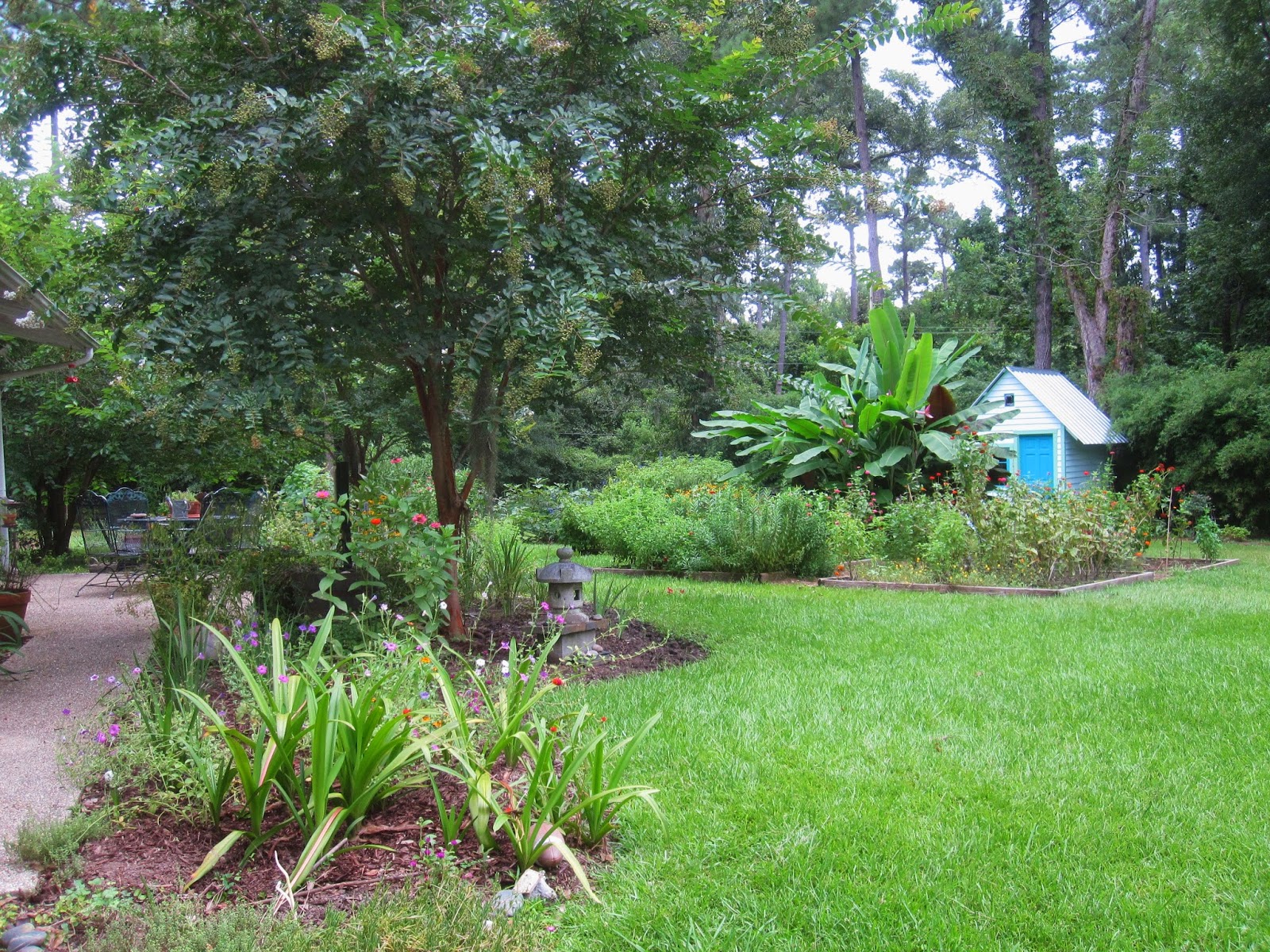
back yard, late July
Last year I kept a closer watch on the pollinators that visited our yard, as I wanted to learn what plants attracted which pollinators, and I encountered all kinds of surprising creatures lurking in my herb and flower beds. I checked my mountain mint patch several times a day. This year I have noticed less pollinator diversity, but that might be because I have been a little less observant. The mountain mint is covered with honeybees most days, and a few bumble bees and tiny wasps, but I have yet to spy an ambush bug or scarlet-bodied wasp moth, both of which I discovered and identified in the mountain mint patch last year.
black swallowtail caterpillar on flat-leaf parsley growing near our patio
black swallowtail butterfly, I think, though other butterflies are often mistaken for it-- photo taken in July
may be a pinevine swallowtail, photo taken in late July
yellow swallowtail butterfly, late July
bumblebee clinging to the bottom of a spotted horsemint leaf, planted in a pot near our patio
honeybee on zinnia flower, late July
I continue to add new flower beds to our 1-acre yard and to monitor the wild flower plants that spring up in the bushier southern lot and along the northern edge of our acre, where I have allowed what I think is fall-flowering aster to proliferate, along with goldenrod. The garden is a respite from Louisiana politics and St. Tammany Parish's boorish commercial culture of parking lots and strip malls. (Downtowns are often nice, though, with old homes, occasional festivals, and farmers' markets.) But I've never enjoyed the heat and humidity of the South--even as a child in southeast Texas, near Houston and the Gulf Coast--and I always look forward to the cooler weather of fall.
The stump of a water oak we had cut down last summer is now surrounded by a flower bed with black-eyed Susans, yellow lantana, and Confederate Rose. By next summer, these plants should fill out the flower bed.
Another water oak stump is surrounded by a flower bed in which Tom planted native Turk's Cap (at the eastern edge of its range), and I have planted native fall asters and yellow lantana. The Turk's Cap will grow into large bushes.
Turk's cap flower'