Showing posts with label Louisiana gardening. Show all posts

Tuesday, January 27, 2015

Leaving my Louisiana Garden

"I want to take my neighbors into the garden
and show them: Here is consolation."
 Paisley Rekdal, "Happiness"
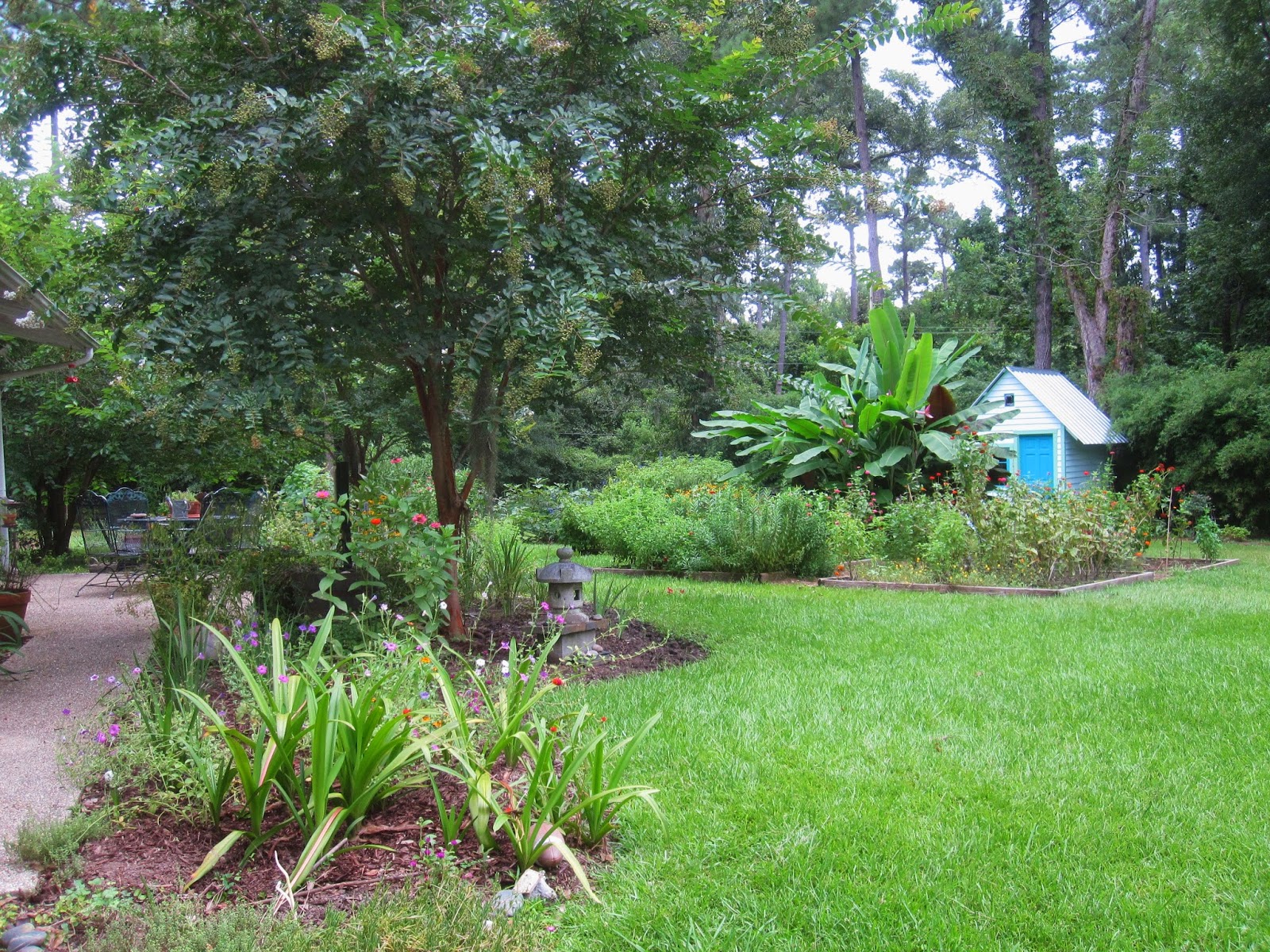
I am leaving my Louisiana garden. Tom and I are moving to another state, a state with much less rainfall and a cooler, drier climate. I leave this garden with some sadness, as it has provided me with entertainment and comfort as well as the beauty of flowers, the spice of herbs and the nourishment of food. Perhaps it's for the best that I am leaving in late winter/early spring, before regret can reach full flower in the azaleas of mid-March, the daylilies of May, the zinnias of late June, the tomatoes of July. 

Right now the garden looks abandoned, because it has been since late November. Except for gathering winter greens, I let the garden go for December and most of January. During a sunny spell last week, I began weeding the patio garden, which was full of chick weed, and adding pine straw that I had raked in our north lot. Violets are already beginning to bloom.

The real estate agent who came by on the weekend was very likely not impressed with the winter yard and gardens, as the grass was brown, the ground thoroughly soaked by more than 3 inches of rain; a stinkhorn was wafting its nauseating odor near the edge of the patio (an annual event this time of year); the herb beds were bare of greenery except for the rosemary bush, the bolting arugula, and the pervasive chick weed that no amount of fall weeding seems to curtail; and empty flower pots were stacked near the garden hose and faucet. The agent's effusive compliments over the photos I later sent her of the garden in its summer glory suggested that the contrast had been noticed. 

We have bought and sold several houses over the course of some 32 years --seven houses, counting this one--so we have some experience in preparing a house for sale.  We have re-painted walls and front doors, de-cluttered, re-arranged furniture for staging, swept and mopped and dusted and cleaned. But I can't hasten spring or make the bright annuals I usually plant from seed flower in February.  We will be gone this year before the ground warms up enough for zinnia seeds. though the azaleas may just be budding as we pull out of the driveway. Any residual radiancy of my garden will be for the benefit of strangers as we head to a less hospitable gardening habitat.
rosemary and black-eyed Susans in July
summer abundance, 2014

Monday, January 5, 2015

A New Year: The Garden I Have Now

early January, aloe vera blooming
In April of 2011, I moved to southeast Louisiana to join my husband, who had been hired as a wildlife refuge planner (Natural Resource Planner) for the U.S. Fish and Wildlife Service. Tom had already been working in Louisiana for ten months. In the almost four years since I have lived here (twenty-five years ago we lived in another Louisiana town while Tom finished his PhD at Louisiana State University and I taught there in the Department of English), I have really enjoyed year-round gardening and recording my gardening experiences on this blog. I first began the blog in 2007--in a different town, in a different state-- as a way to keep myself connected to the world--to demonstrate to my children that even though I had given up on my career, such as it was, I hadn't given up on living and creating a meaningful life beyond a paycheck. In these past four years, I have been involved in social justice issues (creating and writing a blog for a social justice group, attending meetings of the Louisiana legislature, educating myself and then writing letters to local leaders against allowing hydraulic fracturing in our parish with its sole-source water aquifer, among others) and in helping encourage transparency in local government (attending and taking notes at the Planning and Zoning Commission meetings in our small town and publishing those notes on the Facebook page of our local "sustainable growth" organization). Many of my friends here are far more politically active than I am, but I am happy to have done my part--as long as that part did not take me away from my garden too long.

And despite the very wet weather we experienced the last week of the old year and the cooler weather we're experiencing now, the garden is still producing. Our loofah experiment was mixed. The plants grew very quickly, taking over the bamboo trellis Tom built for them and then spreading past the garden and into the yard. The fruits grew huge, but as they were still green when we had our first frost, we were afraid we would lose the entire crop. However, Tom managed to harvest several large fruits that had matured to the fibrous texture of bath sponges, and he is now trying to cure them out. This requires peeling them and soaking the spongy interiors in a solution of bleach and water. The hot, humid Louisiana climate made them moldy, but we will be able to salvage some of the loofahs for sponges.
loofahs
The arugula, mustard mixes, and dill that I planted in the fall are doing very well. Home for the holidays, our daughter suggested that I make an arugula pesto to serve with pasta. I found a recipe online and was very pleased with the result (recipe below).
arugula, mustard, bronze fennel
dill
Our winter garden also includes garlic, which won't be ready for harvest until June, green shallots (onions), and looseleaf lettuce and mesclun mixes. The radishes we planted did not do very well this year. And while the gourd plants grew very promisingly, most of the gourds dropped off the plants and rotted in the humid Louisiana weather. I managed to salvage a couple of gourds, one which I emptied of its seeds and made into a decorative box for my daughter and the other which I painted and kept intact as a musical shaker.

Usually at this time of the year I begin planning my spring garden, but this year we're expecting some big changes in our lives, and so I am enjoying the garden I have now.  

Recipe: Arugula Pesto (Original recipe here)

4 cups packed fresh arugula
1 tablespoon minced garlic
Salt and freshly ground pepper
1 cup pure olive oil
2 tablespoon pine nuts, toasted, plus 1 tablespoon (I used pecans because that is what I had on hand)
1/8 teaspoon vitamin C (optional) (I did not include)
1/2 cup freshly grated Parmesan

Prepare an ice water bath in a large bowl, and bring a large pot of water to a boil. Put the arugula in a large sieve and plunge it into the boiling water. Immediately immerse all the arugula and stir so that it blanches evenly. Blanch for about 15 seconds. Remove, shake off the excess water, then plunge the arugula into the ice water bath and stir again so it cools as fast as possible. Drain well.

Squeeze the water out of the arugula with your hands until very dry. Roughly chop the arugula and put in a blender. Add the garlic, salt and pepper to taste, olive oil, 2 tablespoons of the pine nuts (I used pecans), and the vitamin C, if using. Blend for at least 30 seconds. In this way the green of the arugula will thoroughly color the oil. Add the cheese and pulse to combine. The pesto will keep several days in a tightly sealed container in the refrigerator.

Pull out before dinner to get to room temperature. Before serving, add the remaining 1 tablespoon toasted pinenuts (or pecans or walnuts).

Recipe courtesy Michael Chiarello


Read more at: http://www.foodnetwork.com/recipes/michael-chiarello/arugula-pesto-recipe.html?oc=linkback


gourd box with a crocheted surround that I made
bottom of the gourd box--I made up the pattern as I went along, so I'm glad the crocheted bit turned out as well as it did.

Monday, November 3, 2014

The Melancholy Loveliness of Late-Fall Gardening

iridescent green bee on wild mint
Yesterday we heard the song of the white-throated sparrow for the first time this fall. The sparrow winters in the south and breeds in the north. The first time I heard its call was in a coniferous forest of northern Minnesota; its song was one of the most beautiful things I had ever heard, coming as it did, waveringly, through trees that had not yet become familiar to this daughter of southern pines and Gulf Coastal grasses. Its melody conveyed a hint of cool Arctic air, spicy scent of balsam fir, and a sense of melancholy. I never forgot it. Now, here in southeastern Louisiana, I look forward to this memory of Minnesota made flesh in the flash of a winged shadow in the bushy edges of our yard and in the song that intimates to me presences loved and lost.

The white-throated sparrow arrived with unusually early cold weather. Temperatures dipped to 32°F where we live and broke record lows in towns nearby; the average low for this time of year is 53°F. Fearing frost, I had spent the previous afternoon cutting lemongrass leaves to dry for tea--a task I had promised to do for my daughter who is living in Wyoming--gathering what I thought might be my final bouquet of zinnias for the year, making room for cold sensitive plants in our sunroom, and covering the plants I could not bring inside. We had no frost, however, so the lemongrass still lives for another harvest or two, but our sunroom remains filled with the plants of semi-tropical climates: a pink-flowering bougainvillea, poinsettias, ginger, a red-flowering geranium, a Buddha's hand citrus, and a couple of reed palms.

Our gardens, the larger vegetable garden and the smaller flower and herb beds around our yard, are full of late-fall blooms and ready-to-eat tender greens. In late summer, I cleared away the crusty remains of the zinnias of summer to make way for re-seeded plants, which are shorter and more attenuated than their summer parents but covered with flowers. They began blooming in time for the early fall arrival of gulf fritillaries, painted ladies, yellow sulphurs, and a few swallowtails. In the northeastern corner of our yard, I had allowed native fall aster to spread and grow throughout the summer and have been rewarded not only by a profusion of blooms in plants that can be head-high, but also by the hundreds of bees that busily collect pollen as the shadows of a nearby bamboo hedge retreat during the day. The bees are so besotted with this wild bouquet that they have almost abandoned my cultivated blooms.
partial view of the fall aster patch on an October morning
Paying closer attention to pollinators as I have the past two years, I have noted what plants seem to attract the most bees and other pollinators. The fall asters have attracted several different kinds of bees and wasps, while in a nearby patch of tiny wild mint, I can always spy an iridescent green bee or two flitting from one minuscule bloom to another. These little bees are difficult to photograph, as they seem very wary and fly very quickly in a zigzag pattern. I have noted several sizes of bumblebees; some very large bumbly-type bees love the big yellow luffa flowers. One morning I ventured into the aster patch while it was still in shade, and I discovered dozens of very tiny bumblebees hanging from the blooms and branches where they had over-nighted and were waiting for the sun to warm their wings so they could begin their daily work.


another view of a wary green bee
tiny bee on a fall aster bloom
closer look at the wild mint, to illustrate its size in relation to my fingers
Some wasps are pollinators, too.
black bee-like fly
a hornet-like pollinator
We are already enjoying salads of mesclun and tender mustards from the larger garden and also from the herb beds where I planted seeds of dill, arugula, and mixed greens in late September. The last few weeks have been dry, so I had to water the tender sprouts as they emerged. The habanero peppers, ghost peppers, and green peppers are still bearing, and the luffa fruit are huge. We are a little worried, however, that the luffa will not develop into the dry, spongy product one associates with bath time. The fruits are still green and soft. My gourd crop has been disappointing; too many gourds dropped from the vines and rotted in the hot humid weather of southeastern Louisiana.
a luffa fruit
foreground, arugula, mixed greens among the remains of summer's basil; background, flowering Mexican tarragon
Although temperatures are warmer today, we will have cooler weather again, and pollinators will die or hibernate, some maybe venturing out occasionally during milder winter weather. This morning I heard the song of the white-throated sparrow again as I watched the sun rise above the pines. It will keep me company through the late-fall and winter as leaves fall and flowers fade.
one harvested row of this year's sweet potatoes
second harvested row of this year's sweet potatoes

Sunday, September 28, 2014

The September Garden

habanero peppers
This morning under an overcast sky, the temperature hovers around the mid-70s Fahrenheit. After two or three weeks of neglecting the garden, I ventured out in the early morning while the dew was still on the grass and weeded two of my 8ftX8ft raised herb beds. Although rain has been predicted for today (80% chance), only a few sprinkles fell this morning, and while the soil still has moisture in it a few inches under the surface, we have had a rather dry September. The seed Tom planted in the big vegetable garden a couple of weeks ago has failed to sprout except for one or two little plants. Tom didn't water the seed when he planted it, thinking that rain would soon do the job. Onions are up, however.

The soil in my herb beds is also depleted of nutrients. We scattered some commercial fertilizer across the surface, but that's just a stop-gap measure. I need to add compost to the soil if I want to have a successful fall/winter garden.

The late summer and early fall heat has not been the only thing discouraging me from active gardening. As I have aged, my allergies have become worse, especially in the late summer and fall, and my inner ears are especially affected. Sometimes, as soon as I walk outside, my ears begin to fill with fluid, in an allergic reaction to something in the atmosphere: rag weed? cedar elm? I don't know. It's time for another re-fill of the medication my doctor prescribed, though. Meanwhile, I do what I can, and this morning cooler weather encouraged me to ignore my allergies and spend an hour or so in the garden weeding.

Our daughter grew the poinsettias in a greenhouse class, and I've managed to keep them alive for two years.
The gourd vines are still green, and luffa vines are spreading across the lawn of our north lot. This morning, bees were busy gathering pollen from the luffa blooms; I noted at least four different kinds of bees. The peppers are still bearing, especially the habaneros and the ghost peppers. While the sweet potato vines are growing and spreading, they have been infiltrated by that scourge of the southern garden, Phyllanthus urinaria, and some luffa vines have spread through the potatoes to grasp at the pepper plants. We will have a lot of cleaning up to do after we dig our sweet potatoes.
Luffa vines escaping from the garden trellis
vegetable garden, north lot (far background, bamboo planted by previous owner)
Spider lilies are beginning to bloom.
These are the herb beds I weeded this morning. I left some of summer's basil, purslane, and bronze fennel. The fennel probably would have done better in the fall here.
Mist flower and swamp sunflowers are beginning to bloom (zinnias have re-seeded).
more spider lilies blooming near the spearmint.


Spider lilies coming up in the lawn.


ghost peppers--hot, hot, hot!

Tuesday, September 2, 2014

The August Garden: Chaos

The late summer garden is producing lots of peppers: ghost peppers, habaneros, bells, etc.
A two-week absence from the August garden leads to chaos--knee-high weeds, rotting fruit, gourd vines escaping their trellis, empty bird-feeders, grass in the lawn almost high enough to be baled, and wilting plants that need water despite all those previous weeks of rain. We had traveled west to help our daughter move into her new temporary home, leaving instructions for care of the cat and for just a few potted plants I was especially keen to have survive our absence. A couple of days after returning home, I first set about mowing the lawn, a big job with a push mower, and then I started clearing out the weeds and dead plants in my herb and flower beds. The vegetable garden is a mess, with only peppers bearing prolifically, with a few cherry tomatoes still ripening on the neglected vines. The two rows of sweet potatoes had spread their vines over two or three more rows, and that pesky weed Phyllanthus urinaria (A.K.A., chamberbitter, gripeweed), which can take over a bare spot of ground in short order, poked above the vegetables like umbrellas in a summer shower, the undersides of their leaves heavy with seed.

The second task was to water my herb and flower beds nearer the house. It seemed that the area had a dry spell while we were gone. Of course, as soon as I watered, we got rain, first an afternoon sprinkle, and then days of showers.

August is a hateful month to me. I have never liked the heat of these late summer and early fall months in the South. As sweat poured down my face, I was longing for that cooler climate we left behind in Wyoming and Colorado. National news had also heated up while we were unloading our daughter's belongings from our car and taking hikes in our spare time. The heat of August, I'm convinced, brings out the worst in people.

The back yard in August, from a distance quite nice
A little closer look: zinnias brown with some kind of leaf spot or leaf wilt


I removed dead zinnias and basil from this bed, and am waiting to see what reseeds and how it will grow through the fall.
Within a week after we had returned home, these sprawling Maximillian sunflowers were past their bloom, and I removed them to provide more light and nutrients for the swamp sunflowers.
Butterflies continue to visit the garden.

Sunday, July 27, 2014

The July Garden: Hot and Humid

salsa we canned the first week of July, using tomatoes from our garden
In southeast Louisiana, June and July are the wettest months, and this year has been no exception. According to one source, the rainfall average for June is 5.89 inches and for July 7.23 inches. Our area received almost 11 inches of rain in June, according to official records and to the rain gauge we monitor in one of my herb beds. And according to climatological data supplied by the National Oceanic and Atmospheric Administration, our area received 46.22 inches to 48.24 inches of rain the first six months of this year. The average annual rainfall is, according to various records, anywhere from 60-65 inches a year. Compare that to the average precipitation of the following cities: 
  • Albuquerque, New Mexico:  9.39 inches
  • Duluth, Minnesota: 30.94 inches
  • Austin, Texas: 34.25 inches
  • Atlanta, Georgia: 49.74 inches
  • Crescent City, California: 71.26 inches
  • Seattle, Washington: 37.13 inches
 Add our rainfall totals to high heat (average high of 92F in July), and you can imagine how oppressive summers can be in southeast Louisiana.

For the first time this year, I planted blue borage in one of my herb beds. The plants sprouted and began to grow vigorously. By late June, every plant had succumbed to a fungal disease; the weather was just too wet for borage to thrive. Our tomatoes, also, suffered from the very wet weather, the Cherokee Purple tomatoes being the first to succumb. We did harvest a few Cherokee Purple tomatoes before the plants finally died. Our other tomato plants grew eight or nine feet tall, but they, also, suffered from fungal disease (probably septoria leaf spot), which begins at the bottom of the plants, where rain splashes the spores. These plants did live to provide us with lots of tomatoes though perhaps not as many as might have been possible had they not been affected by the disease. A few fruits continue to ripen on the vines, which look very bedraggled now. Perhaps next year we will mulch the plants after the vines are big enough where the cut worms can't get at them. Mulch should help prevent the splashing of spores.
vegetables from our garden, gathered mid-July
sliced persimmon tomato--The plants did not produce a lot, but the fruits they did produce were big and juicy.
Here at the end of July, the gourd vines are growing vigorously on the bamboo trellis that Tom built, and the cucumbers, climbing with the gourds, are still producing. The yellow squash is probably about finished--I picked one squash yesterday--and the peppers are producing. This year we did not plant any okra, and that was because the ground was just too wet when it was time to plant. Tom did manage to plant sweet potatoes, which are now vining.
gourd and cucumber trellis, late June
gourd and cucumber trellis, late July

gourd and trellis in the vegetable garden, July
 The herb and flower beds in the yard behind the house are on a little higher ground than the vegetable garden, and except for the borage, most seem to be thriving, though the fennel is rather under-whelming. I think I probably should have planted the fennel in late summer, as it might have done better in cooler fall weather. My parsley plants are greening up again, the older leaves having died in the hot summer heat, and the dill has reseeded. Last week I staked and cut back the zinnias, which had grown head-high and tended to fall over as rain loosened their roots. Those are re-sprouting where trimmed, so maybe I'll get a few more flowers through the fall.

Our yard is now very lively with wildlife. The birds like to hide and scratch in the numerous flower beds and to perch on the very tall Maximilian sunflowers and banana trees. Catbirds and mockingbirds--as well as cardinals and red-bellied woodpeckers--peck at the figs as soon as they begin to ripen. We have noted numerous juvenile birds at our bird feeders: cardinals, titmice, Eastern towhees, brown thrashers. And one morning we watched a mother bunny nursing her young bunny near a brush pile Tom left unburned when he realized the baby bunny was living in it. That brush will probably stay in our yard until winter--or at least until we're sure the bunny has moved out. Tom created brush piles on the margins of our property, in the understory, hoping that the bunny would find those less obtrusive piles more suitable for hiding from red-tailed hawks and other predators.
Maximilian sunflowers began to bloom in late July.
Younger black-eyed Susan plants near the patio bloomed in the spring and again in the summer, but these older plants, planted near rosemary and salvia in full sun, did not bloom until July.
back yard, late July
Last year I kept a closer watch on the pollinators that visited our yard, as I wanted to learn what plants attracted which pollinators, and I encountered all kinds of surprising creatures lurking in my herb and flower beds. I checked my mountain mint patch several times a day. This year I have noticed less pollinator diversity, but that might be because I have been a little less observant. The mountain mint is covered with honeybees most days, and a few bumble bees and tiny wasps, but I have yet to spy an ambush bug or scarlet-bodied wasp moth, both of which I discovered and identified in the mountain mint patch last year.
black swallowtail caterpillar on flat-leaf parsley growing near our patio
black swallowtail butterfly, I think, though other butterflies are often mistaken for it-- photo taken in July
may be a pinevine swallowtail, photo taken in late July
yellow swallowtail butterfly, late July
bumblebee clinging to the bottom of a spotted horsemint leaf, planted in a pot near our patio
honeybee on zinnia flower, late July
I continue to add new flower beds to our 1-acre yard and to monitor the wild flower plants that spring up in the bushier southern lot and along the northern edge of our acre, where I have allowed what I think is fall-flowering aster to proliferate, along with goldenrod. The garden is a respite from Louisiana politics and St. Tammany Parish's boorish commercial culture of parking lots and strip malls. (Downtowns are often nice, though, with old homes, occasional festivals, and farmers' markets.) But I've never enjoyed the heat and humidity of the South--even as a child in southeast Texas, near Houston and the Gulf Coast--and I always look forward to the cooler weather of fall.
The stump of a water oak we had cut down last summer is now surrounded by a flower bed with black-eyed Susans, yellow lantana, and Confederate Rose. By next summer, these plants should fill out the flower bed.
Another water oak stump is surrounded by a flower bed in which Tom planted native Turk's Cap (at the eastern edge of its range), and I have planted native fall asters and yellow lantana. The Turk's Cap will grow into large bushes.
Turk's cap flower'