Showing posts with label Louisiana. Show all posts

Tuesday, January 27, 2015

Leaving my Louisiana Garden

"I want to take my neighbors into the garden
and show them: Here is consolation."
 Paisley Rekdal, "Happiness"
I am leaving my Louisiana garden. Tom and I are moving to another state, a state with much less rainfall and a cooler, drier climate. I leave this garden with some sadness, as it has provided me with entertainment and comfort as well as the beauty of flowers, the spice of herbs and the nourishment of food. Perhaps it's for the best that I am leaving in late winter/early spring, before regret can reach full flower in the azaleas of mid-March, the daylilies of May, the zinnias of late June, the tomatoes of July. 

Right now the garden looks abandoned, because it has been since late November. Except for gathering winter greens, I let the garden go for December and most of January. During a sunny spell last week, I began weeding the patio garden, which was full of chick weed, and adding pine straw that I had raked in our north lot. Violets are already beginning to bloom.

The real estate agent who came by on the weekend was very likely not impressed with the winter yard and gardens, as the grass was brown, the ground thoroughly soaked by more than 3 inches of rain; a stinkhorn was wafting its nauseating odor near the edge of the patio (an annual event this time of year); the herb beds were bare of greenery except for the rosemary bush, the bolting arugula, and the pervasive chick weed that no amount of fall weeding seems to curtail; and empty flower pots were stacked near the garden hose and faucet. The agent's effusive compliments over the photos I later sent her of the garden in its summer glory suggested that the contrast had been noticed. 

We have bought and sold several houses over the course of some 32 years --seven houses, counting this one--so we have some experience in preparing a house for sale.  We have re-painted walls and front doors, de-cluttered, re-arranged furniture for staging, swept and mopped and dusted and cleaned. But I can't hasten spring or make the bright annuals I usually plant from seed flower in February.  We will be gone this year before the ground warms up enough for zinnia seeds. though the azaleas may just be budding as we pull out of the driveway. Any residual radiancy of my garden will be for the benefit of strangers as we head to a less hospitable gardening habitat.
rosemary and black-eyed Susans in July
summer abundance, 2014

Sunday, July 27, 2014

The July Garden: Hot and Humid

salsa we canned the first week of July, using tomatoes from our garden
In southeast Louisiana, June and July are the wettest months, and this year has been no exception. According to one source, the rainfall average for June is 5.89 inches and for July 7.23 inches. Our area received almost 11 inches of rain in June, according to official records and to the rain gauge we monitor in one of my herb beds. And according to climatological data supplied by the National Oceanic and Atmospheric Administration, our area received 46.22 inches to 48.24 inches of rain the first six months of this year. The average annual rainfall is, according to various records, anywhere from 60-65 inches a year. Compare that to the average precipitation of the following cities: 
  • Albuquerque, New Mexico:  9.39 inches
  • Duluth, Minnesota: 30.94 inches
  • Austin, Texas: 34.25 inches
  • Atlanta, Georgia: 49.74 inches
  • Crescent City, California: 71.26 inches
  • Seattle, Washington: 37.13 inches
 Add our rainfall totals to high heat (average high of 92F in July), and you can imagine how oppressive summers can be in southeast Louisiana.

For the first time this year, I planted blue borage in one of my herb beds. The plants sprouted and began to grow vigorously. By late June, every plant had succumbed to a fungal disease; the weather was just too wet for borage to thrive. Our tomatoes, also, suffered from the very wet weather, the Cherokee Purple tomatoes being the first to succumb. We did harvest a few Cherokee Purple tomatoes before the plants finally died. Our other tomato plants grew eight or nine feet tall, but they, also, suffered from fungal disease (probably septoria leaf spot), which begins at the bottom of the plants, where rain splashes the spores. These plants did live to provide us with lots of tomatoes though perhaps not as many as might have been possible had they not been affected by the disease. A few fruits continue to ripen on the vines, which look very bedraggled now. Perhaps next year we will mulch the plants after the vines are big enough where the cut worms can't get at them. Mulch should help prevent the splashing of spores.
vegetables from our garden, gathered mid-July
sliced persimmon tomato--The plants did not produce a lot, but the fruits they did produce were big and juicy.
Here at the end of July, the gourd vines are growing vigorously on the bamboo trellis that Tom built, and the cucumbers, climbing with the gourds, are still producing. The yellow squash is probably about finished--I picked one squash yesterday--and the peppers are producing. This year we did not plant any okra, and that was because the ground was just too wet when it was time to plant. Tom did manage to plant sweet potatoes, which are now vining.
gourd and cucumber trellis, late June
gourd and cucumber trellis, late July

gourd and trellis in the vegetable garden, July
 The herb and flower beds in the yard behind the house are on a little higher ground than the vegetable garden, and except for the borage, most seem to be thriving, though the fennel is rather under-whelming. I think I probably should have planted the fennel in late summer, as it might have done better in cooler fall weather. My parsley plants are greening up again, the older leaves having died in the hot summer heat, and the dill has reseeded. Last week I staked and cut back the zinnias, which had grown head-high and tended to fall over as rain loosened their roots. Those are re-sprouting where trimmed, so maybe I'll get a few more flowers through the fall.

Our yard is now very lively with wildlife. The birds like to hide and scratch in the numerous flower beds and to perch on the very tall Maximilian sunflowers and banana trees. Catbirds and mockingbirds--as well as cardinals and red-bellied woodpeckers--peck at the figs as soon as they begin to ripen. We have noted numerous juvenile birds at our bird feeders: cardinals, titmice, Eastern towhees, brown thrashers. And one morning we watched a mother bunny nursing her young bunny near a brush pile Tom left unburned when he realized the baby bunny was living in it. That brush will probably stay in our yard until winter--or at least until we're sure the bunny has moved out. Tom created brush piles on the margins of our property, in the understory, hoping that the bunny would find those less obtrusive piles more suitable for hiding from red-tailed hawks and other predators.
Maximilian sunflowers began to bloom in late July.
Younger black-eyed Susan plants near the patio bloomed in the spring and again in the summer, but these older plants, planted near rosemary and salvia in full sun, did not bloom until July.
back yard, late July
Last year I kept a closer watch on the pollinators that visited our yard, as I wanted to learn what plants attracted which pollinators, and I encountered all kinds of surprising creatures lurking in my herb and flower beds. I checked my mountain mint patch several times a day. This year I have noticed less pollinator diversity, but that might be because I have been a little less observant. The mountain mint is covered with honeybees most days, and a few bumble bees and tiny wasps, but I have yet to spy an ambush bug or scarlet-bodied wasp moth, both of which I discovered and identified in the mountain mint patch last year.
black swallowtail caterpillar on flat-leaf parsley growing near our patio
black swallowtail butterfly, I think, though other butterflies are often mistaken for it-- photo taken in July
may be a pinevine swallowtail, photo taken in late July
yellow swallowtail butterfly, late July
bumblebee clinging to the bottom of a spotted horsemint leaf, planted in a pot near our patio
honeybee on zinnia flower, late July
I continue to add new flower beds to our 1-acre yard and to monitor the wild flower plants that spring up in the bushier southern lot and along the northern edge of our acre, where I have allowed what I think is fall-flowering aster to proliferate, along with goldenrod. The garden is a respite from Louisiana politics and St. Tammany Parish's boorish commercial culture of parking lots and strip malls. (Downtowns are often nice, though, with old homes, occasional festivals, and farmers' markets.) But I've never enjoyed the heat and humidity of the South--even as a child in southeast Texas, near Houston and the Gulf Coast--and I always look forward to the cooler weather of fall.
The stump of a water oak we had cut down last summer is now surrounded by a flower bed with black-eyed Susans, yellow lantana, and Confederate Rose. By next summer, these plants should fill out the flower bed.
Another water oak stump is surrounded by a flower bed in which Tom planted native Turk's Cap (at the eastern edge of its range), and I have planted native fall asters and yellow lantana. The Turk's Cap will grow into large bushes.
Turk's cap flower'

Monday, June 16, 2014

June: Gardening as Process

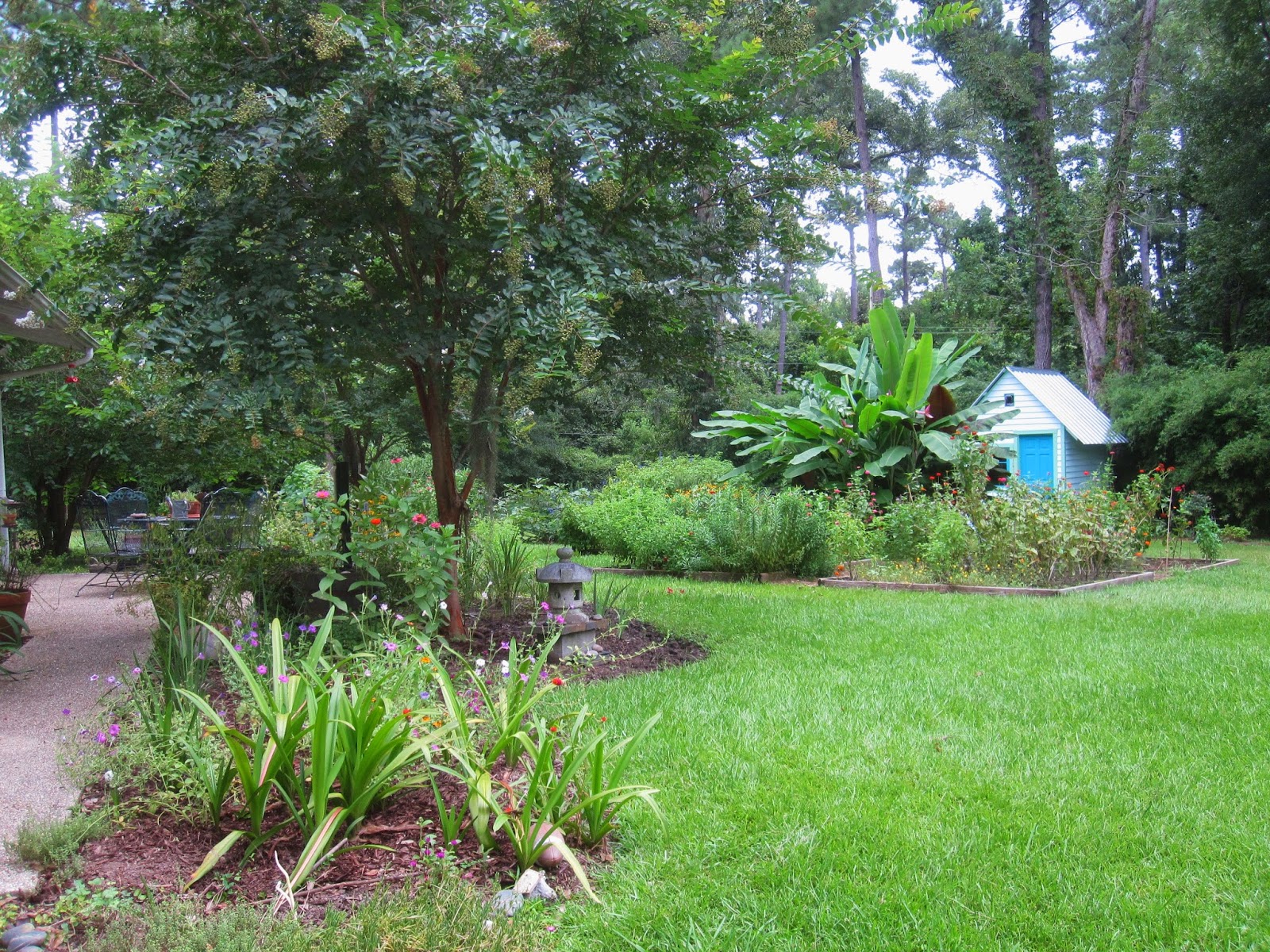
Our back yard, mid-June
Last year the bamboo-covered lot across our dead-end street sold. The lot was cleared of its forest of bamboo, brush, and pine trees, and our little street become much less private as I could now stand on my front porch and see houses on the street beyond ours. For months the house made its slow progress from cleared and leveled ground to roof. Monsoon-like rains fell and made a muddy mess of the tiny yard; trucks parked on its margins, compacting the ground. Then, one day, the house was finished, the new neighbors moved in, and workers showed up to put in a lawn. And that's what they did in one day, arranging neatly trimmed squares of sod and grass all around the house. By evening, our neighbor was watering his grass. By the next morning, the precisely-edged lawn looked as if it had been established for months. Within a couple of weeks, our neighbor was mowing his grass. The house and lawn stood out among its nearby neighbors like a princess among peasants, its suburban perfection at odds with some of the more scruffy elements of the neighborhood.

One resident of the neighborhood had watched the process in awe. "Only in America," she said. "An instant lawn in a day. What a wonderful country!"

In contrast, our yard has been a slow work in progress, and at times it seems as if the elements will win. Grass has been migrating and establishing roots across our gravel driveway. Days of heavy rains encouraged such rapid growth that plants toppled over. Soaked ground loosened roots. Weeds had a holiday and celebrated all across my herb and flower beds. The south lot, especially, is a lot in transition. Tom is still hard at work chopping into firewood the two water oaks we had cut down last summer. He is making progress, and the wood rack is almost full again after a cold winter, but the area remains littered with remnants of wood and bark. I mow around the piles, but grass grows tall between the pieces of remaining wood and waves gaily across the yard to its neatly trimmed and circumspect neighbor like a friendly country cousin.

Gardening for me is a process, but I recognize--and often sympathize with--the urge to have an immediate end result, to hire others to do the work, to buy mature plants every year and rotate those plants in and out of the garden seasonally. That's one kind of gardening. and more power to those who manage such gardens. But I'm willing to work and wait and experiment.

Two years ago, we decided we would have to have the two water oaks nearest our house removed as they threatened the house in this hurricane-prone country. I imagined the stumps of those trees as being the center of flowerbeds and began raking leaves around the water oaks to compost. By the time the trees came down, the leaves had created a layered humus. I had to wait while Tom chopped and stacked the piles of wood nearest the stumps. Then I began hoeing and shaping the beds, removing some of the cast iron plants to a shadier flower bed near our front gate and getting rid of the more easily removed weeds. What we think are two Confederate Rose bushes sprouted spontaneously in one bed; Tom transplanted Turks' Cap in the other, where I also transplanted some native flowers that had sprouted in other areas of our yard. Virginia creeper, brambles, elderberry, and a persistent native plant with bulbous roots had covered the area around one stump, so Tom sprayed the area with Round-Up so that I could remove the weeds more successfully. Their tangled roots spread throughout the soil, and I spent a day last week--between days of rain--clearing the weeds and loosening the soil. This past weekend I transplanted to that new bed Black-eyed Susans that had sprouted near their parent plants in other flower beds in our back yard. We probably won't see any flowers from those plants until next year.

Gardening in southeast Louisiana is tough, as the heat and humidity challenge one's commitment. We had an entire week of rain at the end of May and the beginning of June, with between 10 and 11 inches of precipitation. During the following days of sunshine, we were out of state, attending a wedding, and when we returned, sunny days were offset again with pouring rain. Afternoon showers are common in June. As the planet heats up, humid areas such as southeast Louisiana are projected to have more precipitation and higher temperatures, and gardeners will have to adjust to those changes. Our entire planet is undergoing a process that will enormously affect the lives of not only gardeners but every inhabitant. I hope we're prepared for the work of adjusting.

An afternoon's worth of weeding and thinning my herb and flower beds
weeded flower and herb beds--lemon basil, borage (most of which did not survive the heavy rains), zinnias, dill, portulaca
The once bushy lemongrass has been reduced to one blade-like plant, which I will probably transplant elsewhere. Black-eyed Susan on the far left; rosemary in the middle; blue salvia trying to take over most of the bed; red salvia, far right
white-blooming monarda (bee balm)
Sungold tomatoes beginning to ripen in our vegetable garden
Yellow squash maturing in our vegetable garden
Spearmint loving its new location

Thursday, April 17, 2014

April: At Least There's Gardening

daisy flea-bane in my corner meadow
It's legislative season in Louisiana, and because I attended a series of book-reading discussions at a Unitarian Universalist church at the beginning of 2013, I find myself this year attending committee meetings of the Louisiana House in Baton Rouge. One little decision, and I became enmeshed in politics, dedicated to promoting an issue of social justice and discovering that the system is recalcitrant to change and the folks in charge stuck in the 1950s. I have written letters, sent e-mails, tweeted blunt political views (in less than 140 characters), attended workshops, rallied on the steps of the state capitol, and created another blog for the social justice group that developed from those book-reading sessions.

I have to remind myself that I was once a poet, a reader of novels, a journal keeper and letter writer. These days, I consume online media and follow people on Twitter. My Facebook feed is now dominated by news sites.

But at least there's gardening to ground me, to remind me that while bureaucracies grind on ever so slowly and political systems resist real change, the seasons cycle and magically regenerate.
spring rain on my backyard herb and flower beds
It's been a wet and cool spring here in south Louisiana. Tom the federal worker planted tomatoes he had sprouted and then had to cover each of them with Dixie paper cups two nights ago when temperatures dipped into the mid-thirties. He said there was frost on the windows of his Ford Ranger, but, fortunately, everything in my flower and herb beds was spared. The aloe veras that I took such pains to cover during every freeze or frost this past winter are now blooming, and even basil seeds have sprouted--though slowly. Zinnia seeds are also coming up. Maximillian sunflowers that I planted last year have re-sprouted or re-seeded, our Knockout roses and amaryllis are blooming, the azaleas are past bloom, and pots on our patio are full of violas and nasturtiums.
aloe veras flowering above a cousin's ceramic art
I have left unmowed a northeast corner of the yard, and it has become a meadow of daisy flea-bane, spiderwort, quaking grass, and clover. The composite flowers, only 1/2 to 3/4 inches in diameter, attract bees, wasps, and flies. Honeybees especially like the clover flowers. I mowed a couple of trails through the patch that I walk just about every day, observing other visitors there. The honeybee, with its little legs bulging with pollen, wonders not a whit about what passes as leadership in Baton Rouge. The tiny red spider cares only for its next meal, and sits attuned to the vibrating web it has strung between several stalks of grass.

Yes, I believe in citizen involvement and in doing what one can to make the world a better, more equitable place, but in these first few months of 2014, I have learned again how difficult it is to achieve that goal. So I find comfort in my garden, in remembering we are destined to be gardens, whether we are pushing up carefully tended turf or daisy flea-bane in a corner meadow.
corner meadow with quaking grass, clover, daisy flea-bane
We found this turtle in a lot next door; a day or two later, I found either the same one or another one in my meadow patch.
Large bee fly with its proboscis buried in a wood geranium growing in my meadow patch. Read about it here: http://www.fs.fed.us/wildflowers/pollinators/pollinator-of-the-month/bee_flies.shtml. This was a tiny guy. Those flowers are about 1/4 inch in diameter.
metallic green bee on daisy flea-bane
wasp on daisy flea-bane
honeybee resting on daisy flea-bane
small-headed fly on daisy flea bane--Read about small headed flies here: http://bugguide.net/node/view/7016
another, more ordinarily-shaped fly, on daisy flea-bane
My corner meadow surprises me with four-leaf clovers and many other riches of the plant and animal world.

Friday, February 21, 2014

The February Garden

After the bitterly cold weather caused by "southern excursions" of the polar vortex, here in southeast Louisiana temperatures warmed into the upper 70s this week, reminding us of how quickly the weather can change. If the soil were drier, I might have been tempted to get started with spring planting, but another cool spell is predicted, and the soil is just too wet here to do much serious gardening. The Florida parishes, of which St. Tammany is one, are the wettest parishes in the state. Walking in our backyard is like walking on a spring board, only the springs are broken, and one "splooshes" instead of "spronging" in all but the highest areas. However, for a brief window of two or three days, I managed to get some weeding done in my flower and herb beds around the patio and in my 8'X8' raised beds.

Chickweed is especially abundant in the neglected winter garden, and though I have recently learned that it is a tasty green, according to some, I have viewed it as a very pesky and resistant weed, and I spent hours trying to pull it up, as it had spread prolifically over the winter. As I tried to get all the tiny, clinging, web-like roots out of the ground, I noticed I was scattering the seeds everywhere, so I have only ensured a vigorous return when my weeding guard is down. According to a weed management page of an organic gardening website out of the UK, chickweed is very resilient, its buried seed remaining viable "for at least 25 and probably over 40 years." In addition, "individual seed capsules contain around 10 seeds and the average seed number per plant is 2,200 to 2,700." Perhaps I should just develop a taste for chickweed salad.

Because spring can sneak up on one here, I was anxious to do what garden repair I could before the next rainfall. (We discovered that we had already waited too long to plant Irish potatoes, as we hadn't yet even ordered the seed potatoes.) I trimmed all the bushy bits I had left through the fall for the bees and their brown remainders through early winter for the white throated sparrows to hide among--the branches of Mexican marigold mint, red and blue-black salvia, and the mountain mint near the garden shed. Though we hope our banana trees will re-sprout from the roots, nothing above ground survived the freezes, so I hauled off three or four wheelbarrows full of dead banana leaves and rotting trunks. I also removed all the composting pine needles that I had placed on the pathways between my 8'X8' herb beds, putting down a layer of bark from the water oaks Tom has been chopping up for firewood and a layer of fresh pine bark I raked up in our yard and a neighbor's lot nearby.
sprucing up the garden paths--a layer of bark and then a layer of pine needles (hope I'm not creating cozy homes for slugs)
Then it was on to pulling weeds from the flower bed around the patio and rearranging the outdoor display I re-work every spring, among which I place my potted plants, which are staying warm yet in the sunroom. As soon as the weather settles, I'll move those plants to the north side of the patio and plant seeds--especially nasturtiums--in my other flower pots.
patio arrangement, northside--pots and bottomless basket waiting for seed planting
garden art: folk artist Butch Anthony's square globe and my cousin Karen's earthen habitats
I tried weeding the circular bed around the cedar post bird feeder, but the ground was still sloppy wet. Dill seed had sprouted during the winter, and though the plants had been beaten back by freezes that dipped into the teens, several plants had survived, so I pulled out the weeds around them and left the rest of the flower bed for a warmer and drier day.

Forecasts for next week are suggesting that we will have lows in the twenties, so I'm glad that I postponed any planting or moving the biggest pot plants outdoors. At 6 p.m., today, however, the weather app on my computer tells me that the temperature is in the low 60s, and tomorrow will be a sunny day for the local Mardi Gras parade. I'm just happy that the rain forecast for the end of this week has waited to make its entrance--according to an updated forecast--to Sunday, and I was able to take advantage of these drier, warmer days here at the tail end of a Louisiana winter.
flower bed at the north end of the patio--I'll move the potted plants out here when the weather has settled.
east side of the house: 8'X8' raised herb beds, new pole with bird feeders on the right, new bluebird house in the back
Persephone taking advantage of a warm afternoon on the patio

one of two baskets of tomato seeds that Tom the federal worker planted --they sprouted in the space of two warm days on the patio
Gulf Coast Toad--I caught this fellow out early one morning
Tom's row garden still producing turnips, carrots, onions, mustard greens, some lettuce...and chickweed