Showing posts with label chickens. Show all posts

Sunday, October 1, 2017

At Casa Malpollos: Chickens, of course

When I was a child, my father bought several unusual chickens, among them Turkens (Naked Necks) and Frizzles. There were others, but these are the ones I remember the most because they were so unusual,  so unlike the white Leghorns that my dad's mother, Margaret Cole Dugat, raised for meat and for eggs. Daddy wanted us to experience these unusual chicken breeds, and I credit, to some extent, a tendency to delight in the exotic and different to that early childhood experience of watching these chickens peck around the yard on our 8 acres of family land in Old River, Texas. Our home place had been carved out of woodland that was passed down through several generations and was situated on a hill across an oyster shell-covered road from my dad's parents' home and his birthplace. I and my siblings ran around barefoot all summer long, and as sharp as oyster shells can be, they did not penetrate the tough soles of our hardened feet.

These days, though I walk around bare-footed or sock-footed in my house all day when I am home, I can't walk barefoot onto the gravel-covered backyard that we now own without wincing and pussy-footing just as my cats do. The cats are smarter; they walk on the gravel for the minimal amount of time it takes to get to a smoother surface, such as the railroad ties that border the gravel surface or the larger rocks in the faux stream bed that winds through the back yard. 

As soon as Tom and I had a big enough place on which to raise chickens, I ordered a full run of chicks, choosing a mix of Silver-laced Wyandottes and Ameraucanas. This was the  late 1980s and early 1990s when we rented a small house on a large ranch in Bryan, Texas. The chickens, when grown, roosted in a small wooden henhouse that Tom built on posts. They ran free on the ranch during the day. Because I had ordered a straight run of twenty-one chicks, we had no way of knowing the ratio of hens to roosters until the chickens got old enough to begin demonstrating male or female behavior. There were eleven roosters in that run, and they gave the hens hell until we put all but one rooster in the freezer.

When we moved from Bryan, Texas, to Cloquet, Minnesota, we gave the remaining chickens to the young couple who rented the house after we did. We didn't have chickens again--Ameraucanas--until after we moved to Georgia in 1996. Of that batch of chickens, I chose to keep the prettiest rooster, who also turned out to be the meanest. Our daughter hated that rooster. It met an untimely death when it attacked Tom one day as he was carrying a large flat of tomato seedlings to the garden to be planted. 
the mean rooster in our backyard in Georgia
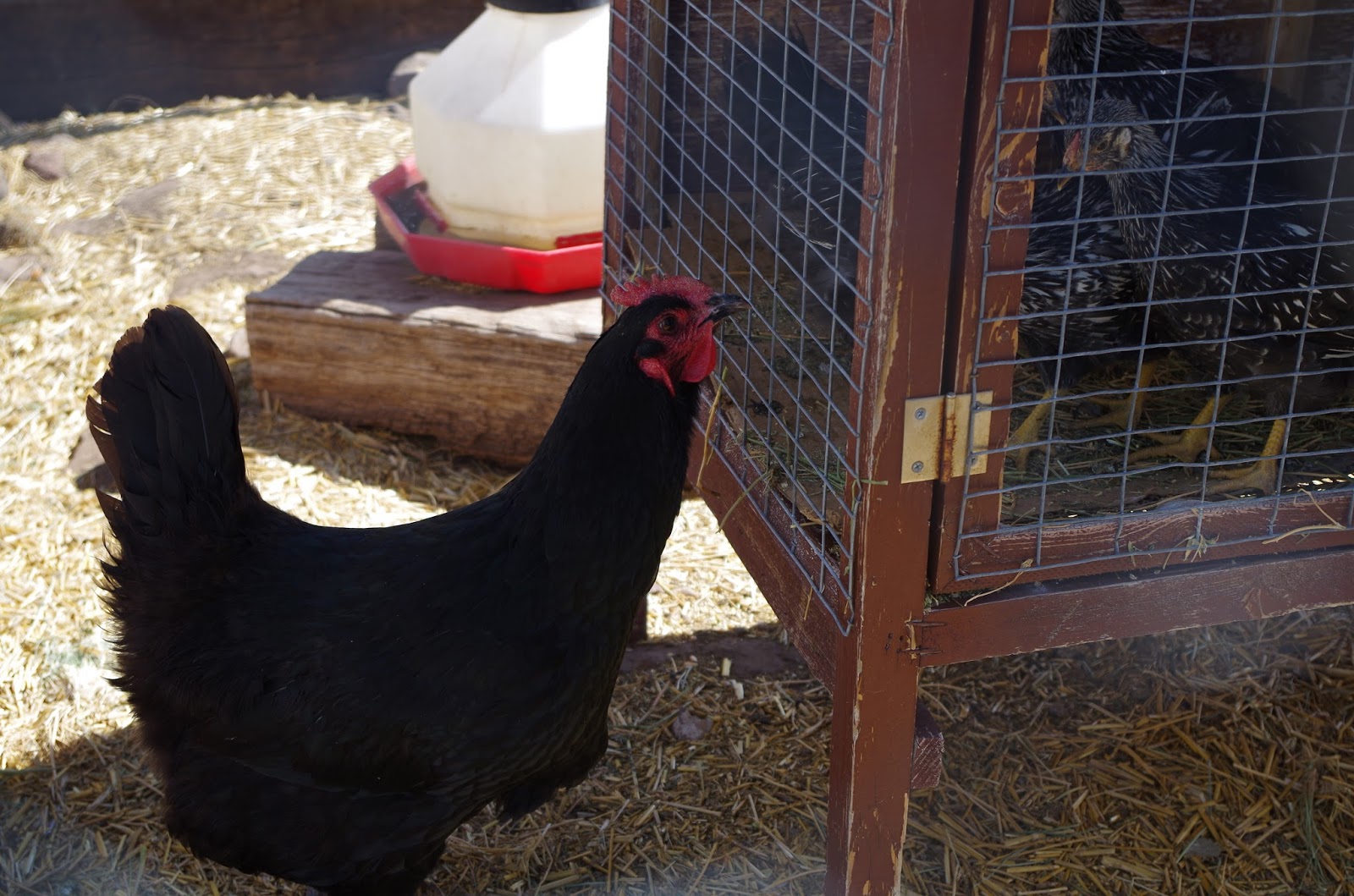
These days, however, Tom is a quasi-vegetarian (avoids meat except fish and crawfish and eats dairy products such as milk, eggs, and cheese) and I am a flexitarian in that I occasionally eat meat, so we are most interested in having laying hens. We had inherited some chickens from the previous owners of this house: one met death by hawk, two died of illnesses, and the roosters ended up being stewed with dumplings. Nine hens now roost in the henhouse: three from the previous flock and six Silver-Laced Wyandottes that we purchased as days-old chicks from a local feed store. The three old hens are a white Leghorn, a black hen that may be an Australorpe, and a red hen that could be a Rhode Island Red. They are almost past their laying years, with the red hen and the white Leghorn still laying eggs but the black hen not.

After a little bantam hen of the original flock was killed by a hawk one evening last fall, we hadn't let the hens out to free forage for almost a year. To make sure they don't become supper for some predator, we have to remain outside to watch them if we let them out of their covered chicken run. However, I like for chickens to have some freedom of the yard, and I was just waiting for the Wyandottes to get older and for me to find the time to sit in the yard to watch while they roamed. I found that time one day last week.

I placed a patio chair under a large juniper tree in the backyard and opened the chicken yard gate. No sooner had I returned to the chair to sit than a small hawk flew into the tree, landing on a branch right over my head. "Oh, no you don't," I screamed and startled the hawk. It flew away, and I moved my chair next to the chicken yard to keep a closer watch on the hens as they ventured out. 

A closer encounter between hens and possible predator occurred later when our cat Persephone (Persey) approached me, mewing for her evening meal. But neither of our cats seems interested in the chickens for food. Cassie is so cautious around them as to seem fearful at times. Persey's first encounter with the young hens outside the hen yard was almost anti-climactic, with the hens showing more interest in her than she in them. 
One of the Wyandottes checks out Persey
Persey seems to be avoiding a direct encounter with the hen.
More hens wander over to investigate.
Some kind of confab seems to be going on.
Eye contact is made and perhaps some secret deal struck between them all.
The meeting is over. Persey is outnumbered and outweighed.
Cassie watches more cautiously from a place in hiding.
I don't really view my chickens as pets, but I am fond of them. I feed them seeds that I have gathered from the stalks of cowpen daisies that bloomed wildly in the back yard in late summer, vegetable matter left over from chopping veggies for dinner, and greens that are going to seed in my kitchen garden. The hens hear my shoes grating on the gravel as I walk to the pen, and they come running, suspecting that I am bringing them something tastier than the gray laying pellets that fill their feeders. I have seen too many chickens slaughtered, have plucked feathers still warm from the hot water into which the limp, dead bodies have been plunged, to be any more than an enemy at truce. 

But even enemies can develop a cautious affection in the right circumstances. I watch these birds that are distantly related to dinosaurs and realize we are all evolving.

Sunday, May 7, 2017

Spring at Casa Malpollos


Snow covers peach blossoms on March 28, 2017
Last year we put in our first full garden in Arizona where we live near the White Mountains, at 7200 feet above sea level. Most of our gardening experience has been in the South (Texas, Georgia, Louisiana) except for a couple of years in northern Minnesota. The monsoon season begins here at the beginning of July, and most long-timers don't begin planting until May. However, we decided to experiment, and I planted cool season seeds (arugula, mesclun mixes, radishes) on April 10th. I followed suit this year, and these cool season plants survived the late freezes that are common here. But the warmer season plants that survived early planting last year were hit hard by those late freezes this year.

The weather here is not consistent, and gardeners are frequently disappointed. Friends who live just five miles away, nearer the Little Colorado River and at a little lower elevation, have never had apples from their apple trees. Yet last year, even though many blooms were killed in a frost, we harvested plenty of apples for canning. This year, we had such warm weather in March that we were encouraged by all the peach and apple blooms. Then the area turned colder, with freezing temperatures and snow the last week of March. 
the snow of 27-28 March 2017--peach tree full of blossoms, covered with snow


We were amazed, however, to see tiny fruit swellings on the peach, pear, cherry, and apple trees--only to be disappointed again by a late freeze and snow on April 29th and 30th. All the little fruits were killed, as well as the tiny, curling leaves just emerging on our grape vines. Even the hardy, ornamental Russian sage was killed back, its spring leaves withering in the cold. I wait to see if those will sprout back. 
The snow of April 29-30, 2017

The garden after the snow of April 29, 2017
With so many spring-flowering plants affected by those snows, the bees, which had been covering the blooms of the fruit trees, began swarming the hardier plants. I had planted arugula and mesclun mixes last fall. The plants hunkered down, survived the winter, and are now in bloom and full of bees every day.
Arugula and mustard flowering in the early spring garden--These plants survived the winter.
The arugula, mesclun mixes, and radishes we planted in early-to-mid April are doing well, potatoes have sprouted, and the garlic has 5- to 6-inch leaves. The parsley that I planted by seed last year also resprouted; they are biennial plants. Today I made a great salad with those greens and parsley.
Arugula and mixed mustards, early May garden
We have also added to our animal quotient on our little half-acre "suburban farm." When we bought this house, the previous owners had chickens and turkeys; we kept the chickens, ate the roosters, and now have four hens left from the original flock. In March, I purchased six little Wyandotte chicks (purported to be pullets at the local feedstore so there better not be any cockerels among them!). For the first three weeks, we kept the chicks in a large box in one of our spare bathrooms where we could set up a heater as well as a heat lamp. Then, as the weather warmed up, we moved the chicks to a rabbit hutch that we put in the garage, again with a heater and heat lamp set up to keep the growing chicks warm. Yesterday we moved the chicks to the hen house. They are in a small cage that Tom built in order to help the older hens and chicks become acquainted, with as little anxiety and pullet pecking as possible. In a week, we will release them into the larger hen yard.
One (of the two) black hens checks out the chicks yesterday (6 April 2017)
chicks in the hen house--The cage will keep them separated from the older hens for a week.
Now we are experiencing the high winds that the area is famous for--wind and very dry weather. Gardening here is a challenge, but so far, we've been up for the challenge.


Wednesday, July 6, 2016

One Year Later in Arizona

It's been a year since I last wrote a post for this blog. I've spent the year learning more about the area where I live and creating living and gardening spaces at my new home. My husband and I are learning to garden in an area that's 7200 feet above sea level and that has an annual rainfall of 10-12 inches, quite a change from our home in Louisiana, which was 35 feet above sea level and had an average annual rainfall of 60 inches. Over the past year, we have built a chicken house, taken down a fence that divided our backyard, built a greenhouse out of the framework of an old chicken house, picked up trash and debris left by former owners, weeded and re-worked long-neglected flower beds, and got our new house in order. We've also hiked many trails in the area, with plans to hike even more. Below are a few photos that illustrate some of the outdoor work of the past year.
July 2015--The yard was full of weeds, the fruit trees
and an old garden area neglected.
July 2015--The old chicken house and yard were ramshackle and dirty.


old hen house and yard


August 2015--new chicken house and yard--Tom built the chicken house and yard; I painted it.


The previous owners cross-fenced the backyard for their several dogs. I removed
the cross-fence to allow unimpeded traffic from the back yard to the fenced-in garden.


Tom built a greenhouse on the frame of the old chicken house.


I don't have a photo of the garden area before I cleaned it up
(lots of trash and weeds), but this is the area in Sept. 2015, after I had spaded it up.


And by June of this year, our Arizona garden was full of leaf lettuce, radishes,
tomatoes, potatoes, corn, beet plants, cucumber sprouts, basil sprouts, etc.


We are settling into our Arizona home.

Saturday, November 7, 2009

Chickens in the City


Today my husband and I attended a two-hour class sponsored by a local community garden project. The subject was on raising chickens in the city, and the teacher was a man who keeps five or so hens in his backyard. Evidently, there are a number of such backyard chicken enterprises throughout our community here on the east side of Atlanta. And the city has ordinances to provide some kind of control on backyard chickens while also not discouraging the practice. The Chickens-in-the-City class is so popular that it usually fills very quickly each time it is offered. One attendee at this morning's class said that she had tried many times to sign up for the class and had been put on a waiting list. On Friday, I received an e-mail from the community garden supervisor advertising that five slots were still available for this class from 10 A.M. to noon, so I quickly signed up online.
 
It was actually quite a lovely way to spend a Saturday morning; temperatures were in the mid-fifties at the beginning of the class, warming to mid-sixties, maybe, by noon. The sky was clear, and beautiful fall leaves stood out brightly against the blue. The teacher had set out a semi-circle of metal folding chairs in his backyard, and his talk was punctuated by the contented clucking of the chickens in the hen yard behind him. (My pleasure in the rather quirky gathering would have been much increased, however, had I not been suffering from a migraine that lingered well into the afternoon and early evening hours.)

I spent my childhood in the country in East Texas, and both my grandmothers raised chickens, as well as my father. My grandmother Margaret Cole Dugat mainly raised leghorns; she had a white henhouse of about one hundred chickens for a while, after she retired from teaching English to middle school children in Barbers Hill (also known as Mont Belvieu), Texas. My grandmother Ruby Scott Benton had a smaller, motley flock of red and brown chickens. And my father chose his chickens by their unique characteristics: Turkens with their featherless necks, Frizzle chickens with upturned feathers, Araucanas that lay blue or green eggs. He chose those chickens just for the delight of his children. But because I grew up in the country, I also knew the downside of raising chickens: snakes and possums in the henhouse, dogs chasing a flock and killing indiscriminately, and first-hand experience with processing chickens for Sunday dinner. I have smelled chicken death and plucked the feathers from many slaughtered chickens. (I never could eat chicken right after participating in processing those chickens for food; it would take about two weeks for me to get that raw, bloody meat smell--as well as the acrid smell of singed feathers--out of my mind.)

When our Chickens-in-the-City teacher turned to the more earthy topics associated with raising chickens, people began shifting a bit uncomfortably in their chairs. He described the raccoon he caught in his henhouse two months ago which he dispatched with a shovel. His Ameraucana hen was so traumatized by the raccoon invasion that she hadn't lain an egg since then; most of the time she crouches under bush cover at the edge of the henyard. The raccoon had killed one hen and left another near death. The chicken owner had to dispatch the second hen in order to diminish her misery, and he described the various ways to kill a chicken. "Can we call you to dispatch our chickens when something like that happens?" one Chickens-in-the-City student asked, plaintively.

I know that I could kill a chicken if I had to, but over the years, I've left the butchering to other people. My husband followed the policy of my grandmother Margaret Cole Dugat: a chopping block and an ax. My grandmother Benton would take a chicken and break its neck by whirling it around and then snapping the neck with a flick of her wrist. I was the chicken-plucker. Most people in the class, however, seemed to be interested mainly in egg production and in the counter-culture act of owning chickens in the back of their very suburban yards.

While standing in the chicken yard looking at the construction of the teacher's henhouse, my husband and I heard the call of a white-throated sparrow, one of my favorite bird songs, perhaps because the song reminds me of the times we hiked in the cool coniferous forests of Minnesota and heard that bird calling from deep within the woods. Despite the migraine, I felt that the Chickens-in-the-City class had exceeded my expectations.

Friday, May 22, 2009

Backyard Chickens

NPR has a piece on urban and suburban backyard chickens, highlighting chickens in Winona Park, a 1940s suburb of Decatur, GA, near Atlanta. I've reared chickens when I lived in the country in Texas and in Georgia, but discovered that some cities allow backyard chickens as long as one follows certain restrictions. Here is the piece on chickens in metro-Atlanta: "Backyard Coops Make Chicks Chic", National Public Radio, May 21, 2009. And, to be fair and balanced, here is a grumpy response about the suburban chicken rave by Jack Shafer, posted last week on Slate: "Bogus Trend of the Week: Raising Backyard Chickens."