Showing posts with label nature. Show all posts

Monday, October 17, 2016

Distraction #1, the beautiful natural world: How to Keep from being Depressed by Today's News

Fall color in the White Mountains
This morning I got on the Internet as I do every morning to read the latest news. As too often, the news is troubling. I've learned that as his campaign collapses, Donald Trump reveals himself to be a poor loser: he's commanding his followers to watch their local polls for "certain" people who may commit voter fraud. This, despite that in-person voter fraud is practically non-existent. Our voting process seems more likely to be hacked by Russians, who seem to want Donald Trump to win the election.  I also read that the Trump campaign got a cousin of one of the women who has accused Trump of sexual assault to release a statement accusing the woman of lying "just for attention." This is what happens when women speak openly of sexual assault: they are immediately attacked, not infrequently by friends and relatives who refuse to believe the personal experience for any number of reasons. (#WhyWomenDontReport) And it seems that Donald Trump is looking to set up a television network that will likely be an outlet for his many conspiracy theories as well as for the alt-right crowd, led by Steve Bannon and Breitbart.com. 

And that's a short list of the news that threatened to throw shade on my day.

What do I do when crappy news or unhappy circumstances beckon the black dog? Well, here I begin a series of posts on what brings me joy when circumstances don't.
  • Looking at the big picture, which is a lot bigger than we once thought
Here in Apache County, Arizona, the Milky Way is still visible, and to do my part in reducing light pollution, I try to keep our outdoor lights off unless we're planning to return home after dark. In July, we set up a telescope and got a good look at the rings of Saturn. But then I turned my binoculars to the Milky Way and was blown away by the millions of stars that are totally invisible in most parts of the country. It turns out that there are even more galaxies in the "observable" universe than we thought: "Hubble Reveals Observable Universe Contains 10 Times More Galaxies Than Previously Thought." Nothing makes one's worries seem more inconsequential than to put them in perspective of a galaxy or a universe. I like to think that there are other worlds out there where sentient inhabitants are doing a better job at being stewards of their worlds and each other than we are.

If the night sky is overcast, the moon too bright, or the lights of the area too bright, one can always go to the NASA website to look at images taken by the Hubble telescope:  https://www.nasa.gov/mission_pages/hubble/multimedia/index.html
  • Paying attention to my own backyard
Immersing oneself in the details can also help distract one from all the worries in the world.  While living in Abita Springs, Louisiana, I began paying attention to all the tiny creatures that lived in or visited my yard and gardens. There are worlds almost unknown to us a step or two from our back doors, with dramas enacted every day. I have watched tiny predators stalk their prey, and I have identified insects I did not know existed until I started prowling around my yard with a camera. Our yard here in Arizona has plenty to interest me, too. Birds come to the feeders and the birdbath I created out of a stump and a large, shallow bowl I purchased at a thrift store. Occasionally, a skunk will wander nocturnally through the yard, and deer will jump the fence, leaving hoof prints in the muddy ground or bare bark on trees they have rubbed against. Rabbits burrow nests in our greenhouse and under roots of trees. Pollinators visit the flowers, and I am learning to identify bees and wildflowers here in my Arizona yard. 
  • Enjoying the changing seasons 
Yesterday Tom and I drove through the mountains while running errands and took a short detour on a national forest road just to look at the aspens in their fall color. A deer crossed the washboard road ahead of us and into a glen covered in golden aspen leaves. We stopped a little later to take photos of a landscape which will be covered in snow in a couple of months. 
Last weekend we hiked a forest trail where we thought we would have a good chance of hearing elk bugling. We were not disappointed. 
Elk cows follow the large-racked male that we got just a glimpse of through the trees.
Since we moved here in March of 2015, we've taken advantage of the beautiful natural areas, hiking on forest trails, along rivers, or up to the top of cinder cones.  Beautiful wildflowers bloom here in the monsoon season, as a hike along the South Fork of the Little Colorado River last summer demonstrated.
Wild bergamot and goldenrod along the South Fork Trail of the Little Colorado River
Coneflowers along the South Fork Trail of the Little Colorado River
more flowers along the South Fork Trail of the Little Colorado River
Nothing lifts the spirits, I think, than being out in nature on a beautiful day--and research seems to prove it. In one study at Stanford University, "volunteers who walked briefly through a lush, green portion of the Stanford campus were more attentive and happier than volunteers who strolled for the same amount of time near heavy traffic." Other studies have shown that walking in green areas can have a measured neurological and physiological effect on people. 

And those days when the weather is not conducive to a walk in the woods, writing about those walks and looking at the beautiful photos I've taken on those walks are pretty good substitutes.

Tuesday, October 8, 2013

Some Thoughts on Public Lands (from a kayak on a bayou)

(photo by Tom)
On the eighth day of the government shutdown, we went fishing....or rather, Tom did. I took along pen, paper, a book about bees (A Sting in the Tale, by Dave Goulson), and a camera. Although we thoroughly enjoyed our approximately nine miles of leisurely paddle, Tom didn't catch anything worth keeping, and listening to NPR on the drive back home, we learned that Congress hadn't passed a continuing resolution to keep last year's budget, and the country was still heading toward default on the debt. But at least we had spent a pleasant day paddling in our kayaks on Bayou Lacombe. I drifted for a while and wrote the following (slightly edited):
We headed to Bayou Lacombe some little time before 8 a.m. and set in at the Main Street boat ramp in Lacombe, south of US 190. The morning was cool and bright. Our plan was to paddle upstream toward the back door of the Bayou Lacombe Centre, the headquarters of the Southeast Louisiana National Wildlife Refuges. Because of the shutdown, the front doors were closed, but the waterway is state land, open to the public. We weren't going to go on the refuge--just peek in the back door from the bayou.
Bayou Lacombe
The first lesson we learned is one we knew but hadn't heeded sufficiently--bayous are twisty and tricksy. We got all the way up to a low bridge on US 190 before we realized we had been traveling a tributary. The bridge was not only too low for us to go under it easily; the water on the other side was not our destination. So we turned back and paddled almost to the boat ramp, finding the branch of the bayou we needed to get to our destination. The US 190 bridge over the main tributary has a much higher clearance, and we made our way under. We still found ourselves going in a circle, as we circumnavigated an island just north of 190, near a house we had looked at when we were house-hunting in 2010. However, the signs of the national wildlife refuge soon appeared. Tom found a shady spot in which to cast his fishing line, and I paddled upstream, taking photos. Kingfishers flew ahead of me, skimming the surface of the bayou. I startled up some mallards, and several anhingas crossed overhead, their necks taut with alarm.
Bayou Lacombe
I am writing this now while in my kayak, drifting. Tom is still trying to catch some fish, though he isn't having much luck. He caught a couple of sunfish that he threw back. It's probably near 1 p.m., if not a little after. We aren't too far from I-12 [we were actually farther than I thought; the bayou twists and turns through the landscape], as I hear traffic in the distance, as well as heavy machinery on the cleared land we passed. I wonder if that's the site of the new waste transfer facility that local people tried to prevent being located too close to this waterway. [still not sure what the cleared area is]
On Bayou Lacombe, one is never far from the sounds and impact of "civilization," but the lands of the refuge provide a respite from the crowd-weary and a haven for wildlife. It's in places such as this, I think, that one can really see the benefit of public lands, lands that are easily accessed by people living in urban areas not so far away. Kids of the middle-class, working class, and working poor in New Orleans can attend the educational events at the Bayou Lacombe Centre. The waterway is accessible to them and not just to the rich folk with their pleasure boats and huge yachts tied up to their docks downstream.
Big boats and little boats on Bayou Lacombe (photo by Tom)
 Wilderness has its pleasures for those with the leisure, modes of transportation, and camping gear to access the backcountry, but wild life refuges at the back door of urban areas provide access for those with limited resources. This is one of the true purposes of public lands--beyond the purpose of maintaining wild areas for the native flora and fauna that would otherwise disappear under the heel of unchecked development. Without these public lands, only the wealthy and well-connected could enjoy the beauties of land kept undeveloped with their monied interests. Every scenic view would be occupied by those who could pay dearly for the privatized pleasure.
Bayou Lacombe
Those who support the radicals in their pursuit of a government shut down and debt crisis don't seem to understand this. They complain about major monuments and national parks being closed yet do not appreciate the human power that maintains those public spaces, from the person who cleans the toilets at the visitor centers to the person who manages the staff who conserve and care for those lands.
duck box and its reflection on the edge of the refuge
During this shutdown, many people have complained about government websites that have been shut down, too. Well, I think every government website should be shuttered as long as the shutdown lasts: those websites are created by content experts as well as computer technology. Those content experts are federal employees, scientists and educators whose expertise is made available to the public. Without adequate funding this expertise would not be shared so readily. Let the public see how our lives would be greatly diminished without these resources, without these public lands, without the government funds that pay federal employees  . . . .
One of the casualties of the shutdown, cancellation of an event that thousands of people look forward to every fall at the Bayou Lacombe Centre
Michele Bachmann has been on the  radio talking about how these are the "End Times," and how we should be happy--"Maranatha, thank you, Jesus," she says. It is very disturbing that people such as she are eager to shut down the U. S. government and not raise the debt limit. Chaos just brings them closer to heaven. Is it any wonder that far-right Christians are anti-government? They don't really think they need to examine the long-term consequences of their actions. They think Jesus will rescue them from their folly in clouds of glory. [I grew up in a similarly End-Times-infused culture, so I know about its power and appeal.]

illuminated cypress and its reflection on Bayou Lacombe: what's up and what's down?
Having written down some of the thoughts that had been swirling around in my head, I finished the paddle in a more optimistic frame of mind, despite the less than cheerful news we heard later on the radio and read online. We pulled our kayaks out of the bayou around 3:30 p.m. Tom caught only a gar and several undersized sunfish. But it was a good day.
Tom showing off the gar he caught; he let it go.


Saturday, October 24, 2009

Cleaning the Creek

Early this morning we headed north to the Georgia Mountains, to Holly Creek, near Chatsworth. The Nature Conservancy was sponsoring a clean-up location for Rivers Alive, "Georgia's annual volunteer waterway cleanup event that targets all waterways in the State including streams, rivers, lakes, beaches, and wetlands," according to the organization's website. Our mission was to clean up a certain length of Holly Creek. We left home before dawn and arrived at Holly Creek a little after 9 a.m., along with several other people. I'm not sure how many people participated at our site because as soon as volunteers arrived, we signed the necessary paperwork, chose a partner, got a trash bag, and went to work. A Boy Sout troop of about eight boys arrived, with their adult sponsors, families with young children showed up, as well as couples and folks on their own. We trudged the creek from around 9 a.m. to noon, and by the end of that time, we had collected many bags of garbage, as illustrated in the photo.

The most disgusting items I found were disposable diapers, especially one group stashed in a hole in a bank of the creek near a picnic area. Because the area had recently received rain, these diapers were not only full of human waste; they had also absorbed a large amount of rain water, so they weighed down one's trash bag quite a lot. Our daughter had the most disgusting experience of the group, however. Leaning down to pick up trash, she plunged her gloved hands into the putrefying remains of a small animal. She quickly returned to the rendezvous site to exchange her gloves for a fresh pair. Tom had the most exciting find: a dollar bill.

Despite the disappointment of discovering that such a pristine-looking area was so littered with human garbage, the clean-up was really quite enjoyable. The day was cloudy and very cool, and the woods created a sensory overload in colors and textures. I took photographs, but photographs cannot duplicate the experience or even a true image of the experience. In one shallow area of the creek, fall leaves had massed just below the surface of the water, creating an impressionistic image like a Monet painting. In another part of the creek where water rushed over and around several big rocks, the movement created a low rhythmic sound like distant, hollow drums. Staghorn moss covered slick areas of ground, fantastic mushrooms grew on the wet humus, bright red sweetgum leaves fluttered down from branches to catch on branches still blanketed with green leaves. Holly Creek is a beautiful place. Too bad people pollute such beautiful, soul-restoring places.


Sunday, October 18, 2009

A Walk in the Woods


This afternoon we took a walk in the woods in Sweetwater State Park, up the blue-blazed trail through the shade of lollolly pines, American beech, sweetgum, slippery elm, and burr oak. The day was beautiful: clear, bright sunny skies and temperatures in the 50s (Farhenheit). I had tested the temperature at the sunny, south side of the house before we left home and thought the air warmer than it really was. When we arrived at the park, the wind was blowing cold off the water of George Sparks Reservoir. Canada geese, coots, and large white geese waddled across the lawn near the lake where we had parked first, but then we drove up to the interpretive center, re-parked, and began our walk through the woods.

Little streams ran through the woods, and once we stopped to turn over rocks, but Tom didn't find anything of interest beneath them. The blue-blazed trail switchbacked up a bluff and then down to the creek, where the remains of an old mill still stands. This mill was once part of a small creek-side settlement before the Civil War. Slaves made the bricks from which the mill was built, and poor white women did the mill work while their husbands were away fighting the war. In 1864, Union soldiers burned the mill, freed the slaves, and loaded up the women and children for transportation to prison in Kentucky. Many of the people never returned...but evidence of their work remains. The old millchase still channels some of the creek toward the mill, but the water returns to the creek through collapsed stone walls of the millchase before reaching the mill. Some walls of the mill stand, and piles of broken brick peek brightly from beneath their thick cover of earth.


Two weeks ago, a lot of countryside around Sweetwater Creek and the Chattahoochee River was underwater, and some roads still remain closed. The trail to the falls was closed with yellow tape across the trail, but we stepped over some of the yellow tape in order to get a closer look at the creek. There in the rocks that tumble downstream and pile up along the banks, I saw small pieces of brick, probably from the mill, that had tumbled and settled with the rocks. Some of the brick pieces were as round and smooth as the tumbled rock, and could have been taken for rock except that their red color stood out among the quartz, gneiss, and mica schist, as illustrated in the photo at the upper left-hand corner of this post. Given enough time, Mother Nature reclaims all that we have ever dared to call our own.


Thursday, May 14, 2009

Dreaming of Birds

Alexander Wilson, Short-eared Owl

This morning I woke later than usual for work, rising out of a dream set in dark hallways where family members passed by like walkers in a mall. But the image that remains with me most vividly is that of a big room with a wooden stairway and large wooden arches framing pane-less windows open to the sky. Crouching in a large area under a landing of the stairway were three huge, beautiful birds, an eagle, an owl, and a bird I could not identify. While the setting of the dream was dark--dark wood, dim room, dark sky--the emotional atmosphere of the dream was suffused with awe and surprise. The birds' feathers glistened, reflecting some faint light, perhaps from somewhere in the room, perhaps from the sky, and the birds were aware but unafraid of the humans standing nearby.
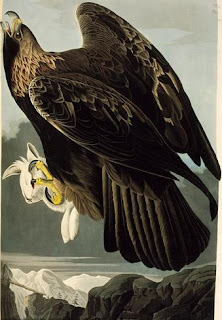
Audubon, Golden Eagle

My dream self was standing slightly above the birds, looking down, as if from steps on the staircase. As I watched, the birds prepared to fly, each stretching its wings fully before launching into the sky. The eagle flew first, up through the wooden arches, then the unknown bird, almost transforming its shape as it passed closely overhead, revealing a long neck and a narrow head. It let out a wild, piercing, plaintive cry as it flew. Briefly, the mood of the dream shimmered into loss, grief, a slight hint of fear. Finally, the owl--a tremendously powerful bird with intelligent, limpid brown eyes set in a large round head with feathery ear tufts--spread its wings and flew up. However, just as it reached eye-level, it turned its head toward me and deliberately spoke. Then it flapped its large, silent wings and disappeared into the sky.

No, I do not remember the words of the owl; I'm not sure that I understood them in the dream. I woke from the dream, dumb-struck, my body heavy on the bed as if the sentience required for moving it still lagged behind in that other, shadowy land.

What might be the significance of this dream? I wondered later, as I sat in the Learning and Tutoring Center where I tutor part-time. It's the end of finals week, and the lab was quiet. I remembered that in many cultures throughout history, owls have been associated with the dead, as messengers of death or omens of evil; others have viewed the owl more positively:

For centuries, all around the world, humans have had a continuous and strong cultural relationship with owls, traceable back 15 000 years to caves in France. Some cultures view owls as omens of bad luck, sickness, and death, while others view them as creator beings, helping spirits, having profound wisdom, oracular powers, or the ability to avert evil. (David Johnson, The Little Owl Conservation, Ecology and Behavior of Athene noctua, Cambridge University Press)

The eagle has less ambiguous associations. In most cultures it is viewed as a symbol of bravery, power, immortality:

As the supreme master of the air, the eagle is one of the most unambiguous and universal of all symbols, embodying, as it does the power, speed and perception of the animal world at its peak, together with majesty, domination, victory, valour, inspiration, and spiritual aspiration. . . .Soaring toward the sun, the eagle seemed a creature capable of carrying souls to heaven--the origin of the Roman custom of releasing an eagle from the pyre of emperors. (Jack Tresidder, The Complete Dictionary of Symbols, Chronicle Books, 2005)

Its opposite is the owl, the bird of darkness and death. (Juan Aduardo Cirlot, translator, Jack Sage, A Dictionary of Symbols, Courier Dover Publications, 2002)

Audubon, Anhinga

And what about that unknown bird, the second one that took to flight, with its narrow iridescent head and long, snake-like neck? An anhinga? The anhinga is also highly venerated in some Native American cultures. According to Peyote and the Yankton Sioux: The Life and Times of Sam Necklace, by Thomas Constantine Maroukis, the "stylized bird" is "represented [in Peyote art] in swift flight, headed skyward and carrying prayers."

I entertained my co-workers for a few minutes by describing this dream and contemplating its significance. Then, with no students to tutor, I opened up the book I had brought this week to read between tutoring sessions: Czeslaw Milosz's poetry anthology, A Book of Luminous Things. The bookmark was placed where I had previously left off reading. The next poem? David Wagoner's "The Author of American Ornithology Sketches a Bird, Now Extinct," a powerful poem about Alexander Wilson, the "Father" of American ornithology, and an ivory-billed woodpecker he had wounded and brought home to sketch. The opening lines of the poem describe Wilson's carrying the bird through town, under his coat:


When he walked through town, the wing-shot bird he'd hidden
Inside his coat began to cry like a baby,
High and plaintive and loud as the calls he'd heard
While hunting it in the woods, and goodwives stared
And scurried indoors to guard their own from harm.

And the innkeeper and the goodmen in the tavern
Asked him whether his child was sick, then laughed.
Slapped knees, and laughed as he unswaddled his prize,
His pride and burden: an ivory-billed woodpecker
As big as a crow, still wailing and squealing.

The poem continues to describe the ivorybill's desperate and futile attempts to escape and the artist's equally stubborn will to capture the bird's image on paper. The powerful impact of the poem is magnified by our knowledge that the bird that Wilson shot--and ultimately killed--to record with ink and paint became extinct around 1880, with only a sighting or two in the twentieth century. There have been some disputed sightings in the twenty-first century, but the search continues for unambiguous evidence that the bird has survived the devastation of its habitat.

Wilson, Ivory-billed Woodpecker and Pileated Woodpecker

What to make of these connections? I'm not sure. However, the dream and the poem that followed do remind me of how we have plundered the natural world, sometimes with the best intentions but with just as devastating consequences as if our actions had been evilly intended. Alexander Wilson left behind the most beautifully-captured illustrations of birds and descriptions of their behavior and habitats. To do that, however, he sometimes disregarded the needs of the bird, tamping down his own empathetic responses to his subject. Wilson wrote about the ivory-billed woodpecker: "While engaged in taking the drawing, he cut me severely in several places, and, on the whole, displayed such a noble and unconquerable spirit, that I was frequently tempted to restore him to his native woods. He lived with me nearly three days, but refused all sustenance, and I witness his death with regret." As a short biography of Wilson indicates, the self-taught ornithologist had a great affection for his subjects, as "he notes the habits and habitats of birds as if they were companions rather than objects of study." Yet to complete that study, the ornithologist often shot the bird to facilitate the process of recording the bird's image.

One ornithologist shooting a bird is no real threat to the natural world, but the attitude that one has the unquestionable right to take the life of another animal--or to destroy the habitat in which it lives-- is a danger. Hence, the long list of animals made extinct, not by some lengthy natural-selection process, but by the unimpeded hubris and greed of humans.

But I digress from my dream. Perhaps the owl was calling my name; in that case, the dream could be a premonition of my death. Or perhaps the owl meant to comfort me; recent suffering in my extended family and concerns about circumstances in my own nuclear family have made me a little anxious. Or perhaps the owl spoke to startle me to attentiveness. The brain continues clicking away while our body sleeps. Psychologists at Harvard University are studying how the brain works during sleep, how sleeping facilitates memory and learning:

The search for answers focuses around a surprisingly small s-shaped area deep in the brain, called the hippocampus. Most neurologists consider this the storehouse for new facts. [Harvard psychologist Matthew] Walker believes that, during sleep, the hippocampus carries on a conversation with the main thinking and organizing part of the brain, the so-called cortex that sits over the top and front of human brains...

Other research has shown that memories seem to be consolidated both during dreamless sleep at the beginning of the night and during dreams that usually occur later. How does this tie in with the conversations between hippocampus and cortex? One idea is that new memories move out of the hippocampus and into the cortex during dreamless sleep earlier in the night. When new and old memories meet, they mix in bizarre and novel ways we call dreams. (William J. Cromie, "Learning While We Sleep and Dream," Harvard Gazette Online, May 3, 2007)

As I left work this afternoon, I was especially alert to the natural world. As I approached the parking lot, I noticed a blue bird, perched on a metal sign post. It sat there for a few minutes as I opened my car door and slid into the driver's seat, heading home.

Alexander Wilson's Work:
"Alexander Wilson, American Ornithologist," American Studies at the University of Virginia.

Wednesday, March 11, 2009

Spring

Spring has not officially arrived, but the weather this week has been very spring-like, more like central Texas than north-central Georgia, with temperatures in the high-70s and low-80s. I'm on spring break, a week's vacation from tutoring part-time, and have spent the first part of the week gardening. So I'm especially attuned to the natural world this week and to all that we do to make it conform to our needs and expectations.

Having this extra time at home has provided me with more opportunities to pay attention to nature in a suburban setting. One morning, I spied a hawk swooping out of the sky to perch on a neighbor's metal fence. It sat there, looking into the shady backyard where a small dog lives, but swiveled its head to watch me warily as I approached from across the street. This hawk must have a nest nearby, for I saw it again a couple of days later, flying up from a perch in another neighbor's yard to circle and drift above the sweetgum and black locust. In fact, this is probably the hawk I've written about previously, the one my daughter observed catching a small mammal.

Yesterday while I was turning over the soil in our garden to mix in the compost, one neighbor who has a home childcare business came across the street with the entire troop, about six young children. They were on a short expedition to look for signs of spring. I was part of the afternoon's exhibit, an example of spring: someone preparing a garden. My neighbor asked the children to guess what I might be planting; most of them guessed daffodils. That is, one boy answered "daffodils," and every child after him gave the same answer. I told them that, yes, I was planting flowers (not daffodils--those will be planted this fall if I prepare the ground in time), herbs, and vegetables.

Earlier today, I spied violets blooming in our backyard, a sure sign of spring to me and a remembrance. Images of violets always bring to my mind a particular place and a certain feeling. The place is my best friend's former home, located in Denham Springs, Louisiana. Chris's shady yard was always covered with violets in the spring; I had never seen so many violets in one place, unexpected jewels on a carpet of pine needles. I will always associate violets with the early days of our friendship, with the excitement that accompanies every new relationship: the joy of discovering a kindred spirit, the exultant hope of future shared experiences. Somewhere, probably in a journal I kept at the time, there is a recipe for Chris's violet jelly. Now Chris (Christine) lives far away from Louisiana, in northern California, a home I have yet to visit. But this memory and its attendant emotions--faded but still felt in the very core of my being--remind me of the promise of every spring, of every friendship, of every distant but unforgotten love.