"It seems to me that I am a character from a work of fiction. This is a serious intuition; it goes deep. For our imaginings about ourselves, whether written down or not, are a composition. Consciousness is like a law of form. My cat, Tiny, does not dream up any stories about himself." --Czeslaw Milosz, A Year of the Hunter, journal entry of Sept. 19, 1987
In 1987, when Czeslaw Milosz wrote those words, I was two months from realizing that I was pregnant with our first child, I was suffering from depression, and I was teaching full-time at Texas A&M University, my alma mater, as a lecturer. Tom and I had just moved back to Texas after four years in Louisiana, where I taught in the English Department while Tom finished his PhD in forestry. I was to discover that drastic changes in my life tended to induce anxiety as I worked to establish myself in whatever new place to which we had located. Over time and after many moves, I have created for myself a fiction--well, not so much a fiction as a story of myself as someone who can adapt easily to new situations.
And so I can adapt, but it's not easy, and it's not without emotional trauma. Now I am adapting to turning 60 at the end of the year, far away from my children and from friends with whom I have kept in touch with over the years. Six years have passed since my last job as a part-time tutor in a learning center at a community college; ten years have passed since my last part-time teaching appointment at a community college; fourteen years have passed since my last full-time teaching appointment, one in which I had achieved a promotion to assistant professor (non-tenure track) and a stint as the director of a summer program for Japanese citizens. Seven years have passed since I last published a poem and about that many since I last wrote one.
In those intervening years, I have struggled to re-invent myself outside of my professional life. It was easiest to postpone that re-assessment while the kids were at home. Once they left on their own adult adventures, the story I told of myself seemed to falter into broken sentences, missed metaphors, faulty plotline. What story can I tell now? One that will get me past 60 and into old age?
When one moves to a new place far away from the old places after one's professional life is over and done with, one discovers no one is interested in that old life. If you remain in the place where you established that professional life or where you have lived for many years, your storyline remains intact; you cannot understand the futility of continuing the story in a totally new place past middle age, beyond your professional life and all the myriad experiences that created the tapestry of your backstory. Really. No one is interested in that story.
We recently had neighbors over one evening for snacks and drinks on our patio, and I mentioned that I missed the culture of cities where I had lived. We had been talking of this place where we live now, a four-hour drive to any major city, in the heart of Apache County, Arizona. Our neighbors are retirees, with a winter home elsewhere and a summer home here in the foothills of the White Mountains. They were telling us of how much they love the peace and quiet of this area, and I mentioned that I miss the culture of cities where I had lived, particularly that of Decatur, near Atlanta, GA. I missed being able to go to a movie on a whim, knowing that I would be able to see the latest production; I missed being able to go to a bookstore when I was bored, to go to a coffee shop and to watch the people passing. I missed the music venues, the festivals, the diversity, the restaurants, the walkable community where we had once lived.
One of our neighbors asked, "Where did you grow up that you now miss those things?"
"I grew up in the country," I said.
"So what makes you miss the stuff you just described?"
I was taken aback and realized...these are people who don't know my story of growing up in the country yearning for something bigger, of going to university and being the first college graduate on the maternal side of my family, of getting married at a young age, of being awarded a graduate degree after two years of teaching freshman composition, of teaching at major universities and regional colleges, of writing and publishing poetry and personal essays in small regional publications, of trying a bit of journalism in a northern Minnesota town, of raising a family while teaching and moving around the country as Tom found new jobs, of getting a full-time teaching position at a university that allowed me to grow intellectually and professionally, of directing a summer program at that university for students of all ages from Japan, of participating in poetry workshops directed by well-known poets, of creating and displaying an art car, of traveling--to England, to Japan, to Mexico, to various states of the U.S.--of making friends and leaving friends along the way.....
That's a too-brief summary of the old life. What story do I tell of myself now?
This is the story my blog tells: Anita is interested in politics and the effects of our political choices, writes about her cats and their presence in her life, is sustained emotionally and physically by gardening, likes to make things, is introspective, and seems to like taking photos of pollinators.
But this is only a small part of the story I tell myself. We all have hidden depths we rarely reveal outside the observable fiction of ourselves.
Monday, May 29, 2017
Sunday, May 7, 2017
Spring at Casa Malpollos
| Snow covers peach blossoms on March 28, 2017 |
The weather here is not consistent, and gardeners are frequently disappointed. Friends who live just five miles away, nearer the Little Colorado River and at a little lower elevation, have never had apples from their apple trees. Yet last year, even though many blooms were killed in a frost, we harvested plenty of apples for canning. This year, we had such warm weather in March that we were encouraged by all the peach and apple blooms. Then the area turned colder, with freezing temperatures and snow the last week of March.
| the snow of 27-28 March 2017--peach tree full of blossoms, covered with snow |
We were amazed, however, to see tiny fruit swellings on the peach, pear, cherry, and apple trees--only to be disappointed again by a late freeze and snow on April 29th and 30th. All the little fruits were killed, as well as the tiny, curling leaves just emerging on our grape vines. Even the hardy, ornamental Russian sage was killed back, its spring leaves withering in the cold. I wait to see if those will sprout back.
| The snow of April 29-30, 2017 |
| The garden after the snow of April 29, 2017 |
| Arugula and mustard flowering in the early spring garden--These plants survived the winter. |
| Arugula and mixed mustards, early May garden |
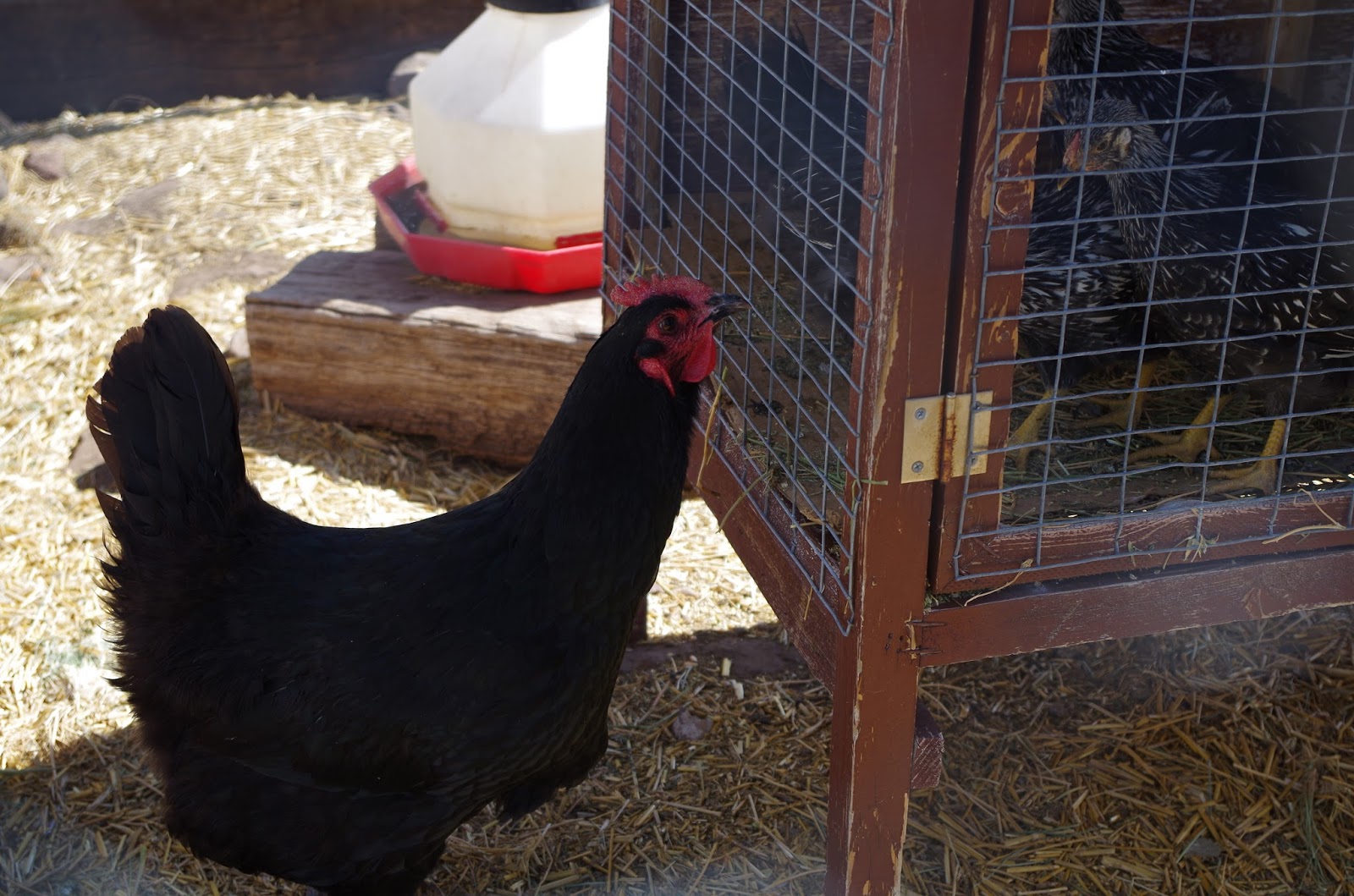
| One (of the two) black hens checks out the chicks yesterday (6 April 2017) |
| chicks in the hen house--The cage will keep them separated from the older hens for a week. |
Monday, March 27, 2017
A Reflection on the First Bees of the Season
| one of the first bees I've seen this season--several buzzing around peach blooms |
The breakfast cereal Cheerios recently highlighted the plight of bees, some species of which are disappearing from our landscapes in record numbers, in a campaign the company called #BringBacktheBees. Every package of Honey Nut Cheerios provided information that encouraged customers to go online to order free packages of wildflower seeds (over 1.5 billion seeds, according to the Cheerios website). In addition, General Mills left a blank space on its packaging where the cereal's mascot Buzz the Bee usually appeared. The ad certainly had an important message, but like a lot of advertising, it over-simplified the problems of reduced habitat and threatened and endangered species. Some of the flower seeds included in the packets are native to some areas in the United States, but not others. This might not be a problem, necessarily, but the flowers might not be ones that native bees of an area usually pollinate.
The other issue is that while honeybees have had some serious problems in hive die-off and those problems have transferred to feral populations of honeybees, it's the native bees that are most seriously endangered. Honeybees are exotic to this country, introduced from Europe by white settlers. Because honeybees are used commercially in agriculture, from those bees transferred from farm to farm to pollinate fruit trees to those bred for honey production, European honeybees will always have moneyed support to fund research when a serious issue arises. Native bees and other pollinators, however, are extremely important in pollinating native plants, and these pollinators are often overlooked in popular Save-the-Bees campaigns.
According to the U.S. Fish and Wildlife Service, pollinators face threats from habitat loss and degradation as well as over-use of pesticides:
As native vegetation is replaced by roadways, manicured lawns, crops and non-native gardens, pollinators lose the food and nesting sites that are necessary for their survival. Migratory pollinators face special challenges. If the distance between the suitable habitat patches along their migration route is too great, smaller, weaker individuals may die during their journey.According to research, native bees do a tremendous amount of work pollinating fruit and vegetables, with honeybees supplementing that pollination. In the words of one researcher, "honeybees can't do it alone." Native bees are most efficient in pollinating watermelons, tomatoes, blueberries, and squash, among other fruits. I have witnessed squash bees pollinating our squash plants here in Arizona.
![]() |
| bee in squash flower (I took this photo in our garden in 2016) |
![]() |
| This was the best photo I could get of the first bumblebee I have seen this season. Bombus huntii? |
Here in Arizona, I am encouraging patches of native flowers as well as allowing dandelions to grow in the small grassy lawn that a previous owner planted in front of our house.
| dandelions in our lawn |
| bee landing on a dandelion in our front yard |
| bee landed and at work gathering pollen |
| deep in pollen |
Wednesday, November 16, 2016
Preparing for Winter....when it comes
| honeybee on California poppy flower |
Tom cleaned out the greenhouse this past weekend, pulling out tomato and pepper plants and replacing them with onion plants. We have a lot of onions in the outside garden, so we'll see how well the onions outside survive the winter as compared to those inside the greenhouse.
| Tomato plants stacked up in front of the greenhouse, Tom and Cassie on the right |
| greenhouse cleared of tomatoes and peppers |
| onions, radishes, greens, cabbage still growing in the garden |
| gutter added to the greenhouse, with downspout for directing precipitation inside |
| drainage gutters for directing precipitation in the greenhouse |
| The area where we plan an herb garden: I am removing gravel and the underlying plastic. |
| I'm recyling the plastic ground cover and gravel to cover bare areas in this gravel walkway. |
| Here is the area repaired, with gravel covering the plastic. |
Another project I'm working on this week is repairing the rock "creek" that was part of the original landscaping of a previous owner. The "creek" was neglected and filled with debris.
![]() |
| The rock "creek" that had been neglected (photo taken in March) |
![]() |
| Dirt, gravel, and other debris had filled in the rock "creek" bed. |
| This week, I cleared out the debris and uncovered buried rocks in the "rock creek." |
| scrub jay at my makeshift bird feeder--some flowers still blooming in mid-November |
Thursday, October 20, 2016
The Fall Garden in Arizona
| path to the garden of Casa Malpollos, decorated with fall leaves from the peach trees |
Clicking on the links in the paragraph above will take you to descriptions of those greens and veggies at Renee's Garden. I have been ordering garden and flower seeds from Renee's since the mid-nineties when Renee's was Shepherd's Garden Seeds. White Flower Farm bought Shepherd's Garden Seeds, and for a time, Renee Shepherd worked for the company that bought out her business. For some years now, however, she has returned to selling product through her own company. The price of the seeds may be a little more than the packets you might get off a Home Depot carousel, but I have never been dissatisfied with my orders, and I love the artwork on the seed packets, too. I re-purpose the packets after planting the seeds.
![]() |
| Re-purposed seed packets from Renee's Garden--just right for tiny gifts or a special note |
| Persey sniffing in the garden; squash going to seed; more green onions than we can eat |
| purple cabbage and green onions |
| Emerald Streaks Mustard, mesclun mix, and arugula |
| Crimson Crunch radishes, recovering from being gnawed by some nefarious garden muncher |
That's a lovely thing about fall: being in the moment, enjoying the last of the produce, and yet looking forward to making improvements to next year's garden.
| climbing nasturtiums on the door to the Secret Garden room |
| fall leaves in the Secret Garden room |
| morning glories still blooming though a little wilted because I've not been watering them |
Wednesday, October 19, 2016
Distraction #3, Gardening and Canning: How I've kept from getting too depressed during the 2016 Presidential Campaign
![]() |
| Cassie at the greenhouse door |
Those of us committed to facts, logic, and spirited but thoughtful and respectful debate have been bombarded with headlines throughout this campaign season that suggest our commitment is a delusion. Sometimes I think that if I hear or read one more "opinion" with no supporting evidence, I'll scream. But then I head to the garden to gather produce or just to look at the plants still surviving here in late fall. Fortunately, the presidential campaign will be over by winter and the first snow.
I find solace in a garden. Part of that comes from the heavy work early in the season; nothing quite pulls one's focus away from a spiral of worries than good, physical labor. Then there is the magic of germination; I never fail to be surprised every year as those hard, tiny seeds I planted break apart and push that first bit of green above the soil. Plucking the spring greens or gathering the first tomato is occasion for celebration. Who can be sad in a garden?
Our first full summer of gardening in Arizona brought us more bounty than we expected. Since Tom re-purposed an old chicken house into a greenhouse in which we planted tomatoes and peppers, our tomatoes there were turning ripe long before those in the larger, open garden. And we still have tomatoes blooming and producing here in mid-October, Sungolds in the outside garden, Celebrities, Sungolds, and even Black Krim in the greenhouse.
![]() |
| preparing to make and can apple chutney |
![]() |
| canned apple slices |
![]() |
| apple jam |
![]() |
| draining apple juice for jelly |
![]() |
| apple-serrano pepper jelly |
![]() |
| our summer canning |
October knew, of course, that the action of turning a page, of ending a chapter or shutting a book, did not end the tale. Having admitted that, he would also avow that happy endings were never difficult to find: 'It is simply a matter,' he explained to April, 'of finding a sunny place in a garden, where the light is golden and the grass is soft; somewhere to rest, to stop reading, and to be content.'
--Neil Gaiman, The Sandman, Vol, 4: Season of Mists
Tuesday, October 18, 2016
Distraction #2, Food and Wine: How to Keep from being Depressed by Today's News
![]() |
| Early summer garden salad, with mesclun mix greens and radishes from our garden |
As the years passed, however, Tom took over a great deal of the cooking. He introduced hand-gathered (by himself and a friend who was Anishinaabe) wild rice for the dishes I learned to cook in Minnesota (wild rice soup; wild rice casserole). He created many variations on veggie stir-fries and Indian curries; lentil and sweet potato soup; tofu, fried with his special spice blend, sauteed with veggies; homemade sushi. I stuck with my old favorites, such as my family recipe of potato soup, modifying it over time: adding sausage and garlic to the simple potato-onion-salt and pepper-liquid (milk and water) recipe; taking out the sausage as two members of the family became vegetarians and adding cheese; carmelizing the onions before adding to the soup; adding homemade vegetable stock to the milk base.
But this summer I began cooking dinner every evening, looking for ways to prepare fresh vegetables from our Arizona garden. Spending time looking for likely recipes online, bookmarking the best ones, thinking of how to modify them to our tastes or to the ingredients on hand were wonderful distractions from focusing on Internet news that was guaranteed to bring up my blood pressure.
And so, when the veggies started coming in, I found recipes to fit our palate, such as Mexican Pepper Casserole from The Moosewood Cookbook. To the original recipe, I added garlic and one thinly sliced yellow squash.
![]() |
| Mexican Pepper Casserole, recipe from the 2014 version of The Moosewood Cookbook, by Mollie Katzen |
![]() |
| Strawberry jello with little strawberry hearts |
![]() |
| Fresh vegetables from our summer garden |
![]() |
| My first tomato pie. The butter pie crust shrank a bit and burned at the edges, but... |
![]() |
| YUM! |
![]() |
| I battered our garden-fresh squash in egg, flour and spices--and fried it. |
| My second attempt at tomato pie; I achieved a more uniform, less blackened crust. I added a nutty bread crumb and Parmesan cheese topping. |
![]() |
| I managed to make one of the prettiest apple pies I had made in a long time, with a double butter crust and apples from our small orchard. |
![]() |
| Squash Casserole |
![]() |
| My first experimental tomato tart |
![]() |
| My first "real" tomato tart |
![]() |
| Rolling out the dough for the pie crust--I added fresh rosemary to the dough. |
![]() |
| The final result: perhaps the last tomato tart of the season |
![]() |
| Why I now need to get back on the elliptical every day |
I do, however, caution about the wine: too much, and you're likely to leave that message on a Facebook page that you have long avoided doing. Please be a bit sparing with the liquor in drowning your political angst. Screaming into your pillow may not wake your neighbors, but it's likely to upset your partner, as sympathetic as he may be.
Another undesired result can be weight gain. Tom and I are going to be eating a lot less cheese-laden casseroles and vegetable pies with butter crusts. I'm looking for simple recipes for canned tomatoes, since Tom canned 53 pints of our summer produce. I just found a cool Gazpacho recipe in The Moosewood Cookbook, just right for winding down after the presidential election, all emotion spent.
Subscribe to:
Posts (Atom)