Thursday, August 3, 2017

And When They are Old They will not Depart from It

I began gardening as a young child, hoeing weeds in my parents' garden, picking peas in my maternal grandmother's garden, and working in the flower beds of my paternal grandmother's garden. As a child, I wandered the fence rows of the eight acres we lived on in Old River, Texas, picking blackberries and nibbling on the seeds of peppergrass. Those eight acres were once a part of a much larger portion of land owned by some of my ancestors, the remaining of which my grandparents and an uncle owned, across the gravel-topped road of Woodland Lane from our house on a hill.

When I was a teenager, one of my first cousins became interested in gathering wild food; I think Karen had read a book by Euell Gibbons, the natural foods guy whom I remember from his claim that many parts of a pine tree are edible. Several of us tested that claim by brewing up some pine needle tea. It tasted terrible, even with added sugar. Then we crawled under a barbed wire fence to gather purslane (Portulaca oleracea) in a pasture next to my cousin's house. Karen had directions on how to cook this prolific plant native to India and Persia; though it's grown as food elsewhere, it's primarily considered a weed in the U.S., except for its cousin, the moss rose (Portulaca grandiflora), which is grown for its colorful flowers.

We boiled the purslane in a pot on my aunt's stove and added butter and salt. I remember having a chance to taste it--a flavor I compared to boiled okra--before my uncle "cottoned on" to what we were doing. He grabbed the pot and flung its contents out into the backyard. "You're going to poison yourselves!" he yelled, thus cutting short our culinary adventure. He was afraid that we hadn't identified the plant accurately.

I haven't eaten purslane since though I have often pulled it up as a weed.

However, those early gardening and foraging experiences have remained with me as I have long been an avid gardener. As college students in the early 1980s, Tom and I gardened in a small plot on land owned by Texas A&M University in College Station, Texas. The university would hire someone to disk up the land and then divide the land into plots. Those of us who lived in married student housing were then invited to choose a plot on which to raise vegetables. We did this for two or three years and grew such a good garden that students toiling in neighboring plots were envious of our success. They were convinced that we had somehow managed to procure a naturally better plot than they--though our trucking in chicken manure from the Poultry Science department and my getting on my hands and knees to pull weeds were the true causes of our success.

So one year, someone rushed to choose the plot we had had the previous year, and, coming in later to the choosing process, we ended up with a corner plot that hadn't been improved. Not daunted, we improved that plot as well, and somewhere I have a faded photo of my twenty-something self standing among flourishing green corn stalks.

Tom and I have gardened together ever since those early days of our marriage as poor college students, from Texas to Louisiana, to Minnesota, to Georgia, and back again in those three states before our latest gardening experiences here below the White Mountains in eastern Arizona. Over the years we've tried new plants, such as mesclun mixes and arugula, some of my now-favorites for green salads, which I first began growing in central Texas. In the late 1990s in Georgia, we began experimenting with heirloom tomatoes, such as Green ZebraYellow Pear, and Cherokee Purple. I would slice up a colorful collection of heirloom tomatoes, season the slices with a little salt and arrange them on a white platter--a dish I called "tomato snacks" to encourage my young children to eat their vegetables. The colorful palette worked.

For almost 40 years, Tom and I have planned our spring gardens together, reviewing the stock of seed we have saved from previous years, poring over seed catalogs, drawing up ideas for new garden arrangements. I imagine that as long as we have a plot of land somewhere, we'll be gardening until we are unable to hold a hoe in our hands or press seeds into soil. 


our Arizona garden, early August 2017
the kitchen garden in mid-July
This is the first time I have grown hollyhocks successfully--and these came up volunteer.

This is one of several different pepper plants--getting big!
from Fall/Winter 2008, Atlanta Review


Monday, May 29, 2017

Turning 60 and the Story I tell of Myself

"It seems to me that I am a character from a work of fiction. This is a serious intuition; it goes deep. For our imaginings about ourselves, whether written down or not, are a composition. Consciousness is like a law of form. My cat, Tiny, does not dream up any stories about himself." --Czeslaw Milosz, A Year of the Hunter, journal entry of Sept. 19, 1987

In 1987, when Czeslaw Milosz wrote those words, I was two months from realizing that I was pregnant with our first child, I was suffering from depression, and I was teaching full-time at Texas A&M University, my alma mater, as a lecturer. Tom and I had just moved back to Texas after four years in Louisiana, where I taught in the English Department while Tom finished his PhD in forestry.  I was to discover that drastic changes in my life tended to induce anxiety as I worked to establish myself in whatever new place to which we had located. Over time and after many moves, I have created for myself a fiction--well, not so much a fiction as a story of myself as someone who can adapt easily to new situations.

And so I can adapt, but it's not easy, and it's not without emotional trauma. Now I am adapting to turning 60 at the end of the year, far away from my children and from friends with whom I have kept in touch with over the years. Six years have passed since my last job as a part-time tutor in a learning center at a community college; ten years have passed since my last part-time teaching appointment at a community college; fourteen years have passed since my last full-time teaching appointment, one in which I had achieved a promotion to assistant professor (non-tenure track) and a stint as the director of a summer program for Japanese citizens. Seven years have passed since I last published a poem and about that many since I last wrote one.

In those intervening years, I have struggled to re-invent myself outside of my professional life. It was easiest to postpone that re-assessment while the kids were at home. Once they left on their own adult adventures, the story I told of myself seemed to falter into broken sentences, missed metaphors, faulty plotline. What story can I tell now? One that will get me past 60 and into old age?

When one moves to a new place far away from the old places after one's professional life is over and done with, one discovers no one is interested in that old life. If you remain in the place where you established that professional life or where you have lived for many years, your storyline remains intact; you cannot understand the futility of continuing the story in a totally new place past middle age, beyond your professional life and all the myriad experiences that created the tapestry of your backstory. Really. No one is interested in that story.

We recently had neighbors over one evening for snacks and drinks on our patio, and I mentioned that I missed the culture of cities where I had lived. We had been talking of this place where we live now, a four-hour drive to any major city, in the heart of Apache County, Arizona. Our neighbors are retirees, with a winter home elsewhere and a summer home here in the foothills of the White Mountains. They were telling us of how much they love the peace and quiet of this area, and I mentioned that I miss the culture of cities where I had lived, particularly that of Decatur, near Atlanta, GA. I missed being able to go to a movie on a whim, knowing that I would be able to see the latest production; I missed being able to go to a bookstore when I was bored, to go to a coffee shop and to watch the people passing. I missed the music venues, the festivals, the diversity, the restaurants, the walkable community where we had once lived.

One of our neighbors asked, "Where did you grow up that you now miss those things?"

"I grew up in the country," I said.

"So what makes you miss the stuff you just described?"

I was taken aback and realized...these are people who don't know my story of growing up in the country yearning for something bigger, of going to university and being the first college graduate on the maternal side of my family, of getting married at a young age, of being awarded a graduate degree after two years of teaching freshman composition, of teaching at major universities and regional colleges, of writing and publishing poetry and personal essays in small regional publications, of trying a bit of journalism in a northern Minnesota town, of raising a family while teaching and moving around the country as Tom found new jobs, of getting a full-time teaching position at a university that allowed me to grow intellectually and professionally, of directing a summer program at that university for students of all ages from Japan, of participating in poetry workshops directed by well-known poets, of creating and displaying an art car, of traveling--to England, to Japan, to Mexico, to various states of the U.S.--of making friends and leaving friends along the way.....

That's a too-brief summary of the old life. What story do I tell of myself now? 

This is the story my blog tells: Anita is interested in politics and the effects of our political choices, writes about her cats and their presence in her life, is sustained emotionally and physically by gardening, likes to make things,  is introspective, and seems to like taking photos of pollinators.

But this is only a small part of the story I tell myself. We all have hidden depths we rarely reveal outside the observable fiction of ourselves.

Sunday, May 7, 2017

Spring at Casa Malpollos


Snow covers peach blossoms on March 28, 2017
Last year we put in our first full garden in Arizona where we live near the White Mountains, at 7200 feet above sea level. Most of our gardening experience has been in the South (Texas, Georgia, Louisiana) except for a couple of years in northern Minnesota. The monsoon season begins here at the beginning of July, and most long-timers don't begin planting until May. However, we decided to experiment, and I planted cool season seeds (arugula, mesclun mixes, radishes) on April 10th. I followed suit this year, and these cool season plants survived the late freezes that are common here. But the warmer season plants that survived early planting last year were hit hard by those late freezes this year.

The weather here is not consistent, and gardeners are frequently disappointed. Friends who live just five miles away, nearer the Little Colorado River and at a little lower elevation, have never had apples from their apple trees. Yet last year, even though many blooms were killed in a frost, we harvested plenty of apples for canning. This year, we had such warm weather in March that we were encouraged by all the peach and apple blooms. Then the area turned colder, with freezing temperatures and snow the last week of March. 
the snow of 27-28 March 2017--peach tree full of blossoms, covered with snow


We were amazed, however, to see tiny fruit swellings on the peach, pear, cherry, and apple trees--only to be disappointed again by a late freeze and snow on April 29th and 30th. All the little fruits were killed, as well as the tiny, curling leaves just emerging on our grape vines. Even the hardy, ornamental Russian sage was killed back, its spring leaves withering in the cold. I wait to see if those will sprout back. 
The snow of April 29-30, 2017

The garden after the snow of April 29, 2017
With so many spring-flowering plants affected by those snows, the bees, which had been covering the blooms of the fruit trees, began swarming the hardier plants. I had planted arugula and mesclun mixes last fall. The plants hunkered down, survived the winter, and are now in bloom and full of bees every day.
Arugula and mustard flowering in the early spring garden--These plants survived the winter.
The arugula, mesclun mixes, and radishes we planted in early-to-mid April are doing well, potatoes have sprouted, and the garlic has 5- to 6-inch leaves. The parsley that I planted by seed last year also resprouted; they are biennial plants. Today I made a great salad with those greens and parsley.
Arugula and mixed mustards, early May garden
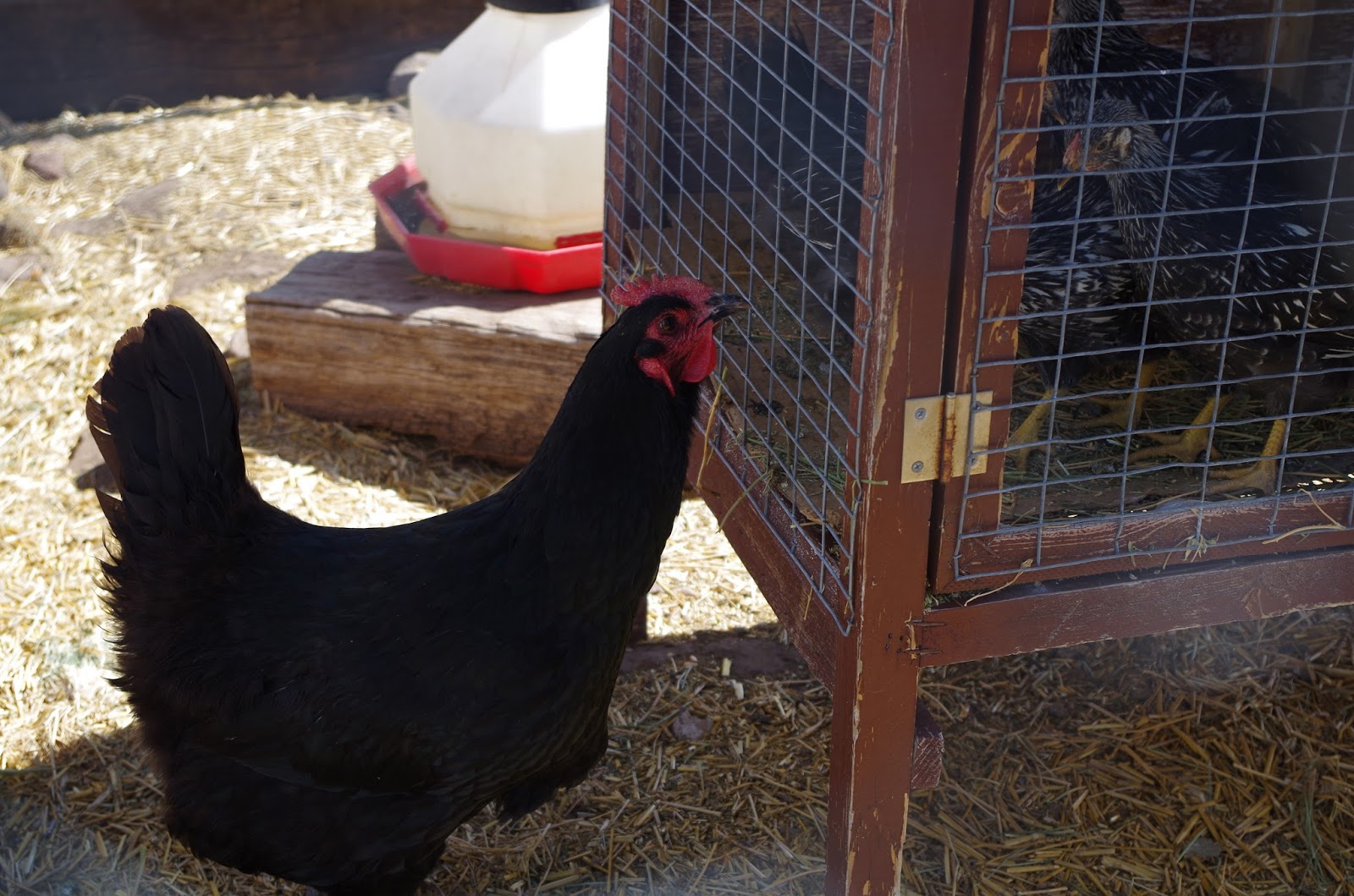
We have also added to our animal quotient on our little half-acre "suburban farm." When we bought this house, the previous owners had chickens and turkeys; we kept the chickens, ate the roosters, and now have four hens left from the original flock. In March, I purchased six little Wyandotte chicks (purported to be pullets at the local feedstore so there better not be any cockerels among them!). For the first three weeks, we kept the chicks in a large box in one of our spare bathrooms where we could set up a heater as well as a heat lamp. Then, as the weather warmed up, we moved the chicks to a rabbit hutch that we put in the garage, again with a heater and heat lamp set up to keep the growing chicks warm. Yesterday we moved the chicks to the hen house. They are in a small cage that Tom built in order to help the older hens and chicks become acquainted, with as little anxiety and pullet pecking as possible. In a week, we will release them into the larger hen yard.
One (of the two) black hens checks out the chicks yesterday (6 April 2017)
chicks in the hen house--The cage will keep them separated from the older hens for a week.
Now we are experiencing the high winds that the area is famous for--wind and very dry weather. Gardening here is a challenge, but so far, we've been up for the challenge.


Monday, March 27, 2017

A Reflection on the First Bees of the Season

one of the first bees I've seen this season--several buzzing around peach blooms
For the past few years I have been stalking bees and other pollinators in my gardens, first in Louisiana and now in Arizona. Taking photos of pollinators has opened up a whole new world to me, a world that we usually pass with little thought. I have identified creatures that I didn't even know existed and have watched dramas unfold in flowers. Paying attention to bees, wasps, moths, butterflies, and other pollinators has also made me more aware of the importance of sharing this world responsibly. It's an awareness that's gaining ground with a lot of people, including some corporations. 

The breakfast cereal Cheerios recently highlighted the plight of bees, some species of which are disappearing from our landscapes in record numbers, in a campaign the company called #BringBacktheBees. Every package of Honey Nut Cheerios provided information that encouraged customers to go online to order free packages of wildflower seeds (over 1.5 billion seeds, according to the Cheerios website). In addition, General Mills left a blank space on its packaging where the cereal's mascot Buzz the Bee usually appeared. The ad certainly had an important message, but like a lot of advertising, it over-simplified the problems of reduced habitat and threatened and endangered species. Some of the flower seeds included in the packets are native to some areas in the United States, but not others. This might not be a problem, necessarily, but the flowers might not be ones that native bees of an area usually pollinate.

The other issue is that while honeybees have had some serious problems in hive die-off and those problems have transferred to feral populations of honeybees, it's the native bees that are most seriously endangered. Honeybees are exotic to this country, introduced from Europe by white settlers. Because honeybees are used commercially in agriculture, from those bees transferred from farm to farm to pollinate fruit trees to those bred for honey production, European honeybees will always have moneyed support to fund research when a serious issue arises. Native bees and other pollinators, however, are extremely important in pollinating native plants, and these pollinators are often overlooked in popular Save-the-Bees campaigns. 

According to the U.S. Fish and Wildlife Service, pollinators face threats from habitat loss and degradation as well as over-use of pesticides:
As native vegetation is replaced by roadways, manicured lawns, crops and non-native gardens, pollinators lose the food and nesting sites that are necessary for their survival.  Migratory pollinators face special challenges.  If the distance between the suitable habitat patches along their migration route is too great, smaller, weaker individuals may die during their journey.
According to research, native bees do a tremendous amount of work pollinating fruit and vegetables, with honeybees supplementing that pollination. In the words of one researcher, "honeybees can't do it alone." Native bees are most efficient in pollinating watermelons, tomatoes, blueberries, and squash, among other fruits. I have witnessed squash bees pollinating our squash plants here in Arizona. 
bee in squash flower (I took this photo in our garden in 2016)
And every year I listen for the arrival of bumblebees in our tomato patch. They seem less prolific than other bees. Yesterday while trying to take photos of bees visiting the blooms on one of our peach trees (blooms which will probably be hurt by freezing temperatures expected this week), I heard and then saw one lonely bumblebee buzzing around the blooms at the top of the tree. 
This was the best photo I could get of the first bumblebee I have seen this season.
Bombus huntii?
I have never understood the urge to create large, uniform swathes of green lawn and roadsides, and knowing what I know now about the degradation of pollinator habitats, I am even more adverse to those boring expanses of green, often made even more desolate by pesticides. In Louisiana, I let a large patch of daisy fleabane grow in a corner of our yard and was rewarded with being able to view and photograph the hundreds of pollinators that visited that patch. 

Here in Arizona, I am encouraging patches of native flowers as well as allowing dandelions to grow in the small grassy lawn that a previous owner planted in front of our house.
dandelions in our lawn
Yesterday I counted four different species of bees pollinating the peach blossoms in one tree (with the coming freeze, at least the bees got some pollen; we're not likely to get peaches.) Each species had a different buzzy hum. The natural world is full of music, if we only stop to listen.
bee landing on a dandelion in our front yard
bee landed and at work gathering pollen
deep in pollen

Wednesday, November 16, 2016

Preparing for Winter....when it comes


honeybee on California poppy flower 
This past weekend and into this week, Tom and I have been cleaning up our place, preparing for winter. Winter seems to be tarrying elsewhere, though. Yesterday I stopped by a local antique shop and while paying for my purchases, asked the owner if it seemed unseasonably warm here. She told me yes, that the area usually gets its first snow in October. However, last winter, our first here, we didn't get snow until December, if I remember correctly.  The U.S. climate data website supports my memory. In November of last year, the highest temperature in November was on the second of the month, with a high near 74°F, while highs the rest of the month varied between 66°F and 42°F, with lows between 45°F and 7°F. Well, we've had a balmy fall, with highs in the 60s and 70s almost every day, giving us a great opportunity to work outside.

Tom cleaned out the greenhouse this past weekend, pulling out tomato and pepper plants and replacing them with onion plants. We have a lot of onions in the outside garden, so we'll see how well the onions outside survive the winter as compared to those inside the greenhouse. 
Tomato plants stacked up in front of the greenhouse, Tom and Cassie on the right
greenhouse cleared of tomatoes and peppers
onions, radishes, greens, cabbage still growing in the garden
Tom also affixed a rain gutter to the greenhouse and used plastic gutter material to direct precipitation into the greenhouse.
gutter added to the greenhouse, with downspout for directing precipitation inside
drainage gutters for directing precipitation in the greenhouse
I finally turned to a project that I had procrastinated on because it was a little overwhelming, repairing the gravel walkway in our backyard which the previous owners' dogs had torn up. To do this, I would be tackling two projects at once, adding to the walkway the gravel I'm removing from an area where we plan to put in an herb garden. Photos might describe these projects best.
The area where we plan an herb garden: I am removing gravel and the underlying plastic.
I'm recyling the plastic ground cover and gravel to cover bare areas in this gravel walkway.
Here is the area repaired, with gravel covering the plastic.
When I get all the plastic ground cover and gravel removed from the area where we are planning an herb garden, Tom will dig up the ground (I've asked for his assistance in this), and then we will put in walkways and separate raised beds. I hope we can get this done in time for spring planting. 

Another project I'm working on this week is repairing the rock "creek" that was part of the original landscaping of a previous owner. The "creek" was neglected and filled with debris.
The rock "creek" that had been neglected (photo taken in March)
Dirt, gravel, and other debris had filled in the rock "creek" bed.
This week, I cleared out the debris and uncovered buried rocks in the "rock creek."
Tom said yesterday that I was going to get the yard all in order in time for us to move again. "Well," I replied, "that would be par for the course." The 2016 presidential election has already impacted some of our hopes for the future. I just hope that the fallout will not be as bad as we imagine.
scrub jay at my makeshift bird feeder--some flowers still blooming in mid-November

Thursday, October 20, 2016

The Fall Garden in Arizona

path to the garden of Casa Malpollos, decorated with fall leaves from the peach trees
Tonight's low will approach 32°, but the rest of the week the lows will be in the 40s, so our cool-weather loving garden plants should be fine. We've had a string of clear, pleasantly cool days, and today was no exception. The cats and I wandered out to the garden around 8:30 this morning, where Cassie browsed on some grass, and I plucked and munched on a few Sungold tomatoes and some mixed mustard greens. If we don't have any hard freezes for a while, we may be able to harvest some Crimson Crunch radishes though I planted the seed a little late (on September 11th) for our altitude and something gnawed them down to the ground not long after they sprouted. They are recovering, and the tiny radishes are fleshing out. That same day, I planted Italian Arugula, Runway Arugula, Wine Country Mesclun and Ruby & Emerald Streaks Mustard. Arugula sprouted in mid-to-late August near my weed compost pile (veggie remains go in a separate compost pile that I will dig into the garden after they have composted). I must have scattered some seed there from my early spring arugula, so next year I should plant these seeds in mid-to-late August for an early fall crop. 

Clicking on the links in the paragraph above will take you to descriptions of those greens and veggies at Renee's Garden. I have been ordering garden and flower seeds from Renee's since the mid-nineties when Renee's was Shepherd's Garden Seeds. White Flower Farm bought Shepherd's Garden Seeds, and for a time, Renee Shepherd worked for the company that bought out her business. For some years now, however, she has returned to selling product through her own company.  The price of the seeds may be a little more than the packets you might get off a Home Depot carousel, but I have never been dissatisfied with my orders, and I love the artwork on the seed packets, too. I re-purpose the packets after planting the seeds.
Re-purposed seed packets from Renee's Garden--just right for tiny gifts or a special note
After Cassie and Persey did their rounds in the garden, sniffing plants and looking for insects to catch (Cassie brought a grasshopper in the house yesterday), I watered the purple cabbage that Tom planted. We haven't had any rain for days; the monsoon season is past.
Persey sniffing in the garden; squash going to seed; more green onions than we can eat
purple cabbage and green onions
Emerald Streaks Mustard, mesclun mix, and arugula
Crimson Crunch radishes, recovering from being gnawed by some nefarious garden muncher
Outside the garden, native flower plants are going to seed. I enjoy pinching the dry seed heads of the cowpen daisy that came up volunteer in our back yard and watching the seed spread in the wind. Birds will eat some, and our chickens, which we often let out of their pen in the evenings, will peck up some of the seed, too, but I'm hoping to get a beautiful, bright crop in the 2017 monsoon season. And those wildflowers I planted are doing really well on the northeast side of the house. 

That's a lovely thing about fall: being in the moment, enjoying the last of the produce, and yet looking forward to making improvements to next year's garden.
climbing nasturtiums on the door to the Secret Garden room
fall leaves in the Secret Garden room
morning glories still blooming though a little wilted because I've not been watering them

Wednesday, October 19, 2016

Distraction #3, Gardening and Canning: How I've kept from getting too depressed during the 2016 Presidential Campaign

Cassie at the greenhouse door
I should have noted in the past two posts that these techniques to avoid depression during a more-than-usually contentious presidential campaign are ones that work for me; other people will have their own ways of coping. What I'm promoting here is the need to step away from the 24-hour news cycle, whether one accesses it on the Internet or cable television, to maintain one's equilibrium during these divisive times. I am also referring to depression as a general feeling of powerlessness and sadness in response to the focus on hatefulness in the news. Do we really need another conspiracy theory to rile up a mob of voters? Can we stand another video of so-called patriots screaming "Lock her up," suggesting that it's a good idea to prosecute one's political opponents

Those of us committed to facts, logic, and spirited but thoughtful and respectful debate have been bombarded with headlines throughout this campaign season that suggest our commitment is a delusion. Sometimes I think that if I hear or read one more "opinion" with no supporting evidence, I'll scream. But then I head to the garden to gather produce or just to look at the plants still surviving here in late fall. Fortunately, the presidential campaign will be over by winter and the first snow.

I find solace in a garden. Part of that comes from the heavy work early in the season; nothing quite pulls one's focus away from a spiral of worries than good, physical labor. Then there is the magic of germination; I never fail to be surprised every year as those hard, tiny seeds I planted break apart and push that first bit of green above the soil. Plucking the spring greens or gathering the first tomato is occasion for celebration. Who can be sad in a garden?

Our first full summer of gardening in Arizona brought us more bounty than we expected. Since Tom re-purposed an old chicken house into a greenhouse in which we planted tomatoes and peppers, our tomatoes there were turning ripe long before those in the larger, open garden. And we still have tomatoes blooming and producing here in mid-October, Sungolds in the outside garden, Celebrities, Sungolds, and even Black Krim in the greenhouse.

I have described in earlier posts some of our Arizona gardening experiences--here, here, here, and here--so there is no need to reprise those. We ate well from our garden this year, and then we began canning our produce for later consumption, learning as we went. 
preparing to make and can apple chutney
Tom started first on the tomatoes; he canned a total of about 53 pints. Then we began canning the apples from our apple trees; we had so many that we shared boxes of apples with neighbors. I first tried an apple chutney recipe. Tom began with apple sauce and then apple jam, discovering after the first batch of jam that we should pulse the apple pieces in a food processor for a prettier jam. With apple slices, apple jam, apple chutney, apple sauce, Red Hot apple jelly, and apple-serrano-pepper jelly, we have enough canned apple products to share over and over again.
canned apple slices
apple jam
draining apple juice for jelly
apple-serrano pepper jelly
When the first snows manage to get above the mountains and  settle into the dryer Round Valley, we will still be eating tomatoes from our garden, in soups and salsas; spreading jam and jelly from our apples on our morning toast; making apple pie from apple slices we canned; topping our ice cream with apple sauce and adding the sauce to recipes for muffins and pancakes. When the 44th President of the United States moves out of the White House and the 45th is sworn in, we will be enjoying the sweetness of our summer garden--and forgetting, I hope, the bitterness of that same summer's presidential campaign.
our summer canning
October knew, of course, that the action of turning a page, of ending a chapter or shutting a book, did not end the tale. Having admitted that, he would also avow that happy endings were never difficult to find: 'It is simply a matter,' he explained to April, 'of finding a sunny place in a garden, where the light is golden and the grass is soft; somewhere to rest, to stop reading, and to be content.'
--Neil Gaiman, The Sandman, Vol, 4: Season of Mists